3 October 1990 Reunification: What Actually Changed for Berlin

3 October 1990 Reunification: What Actually Changed for Berlin
On 4 October 1990, the Berlin reunification was already 24 hours old and the city woke up to a legal framework that had shifted overnight. The Treaty on the Final Settlement with Respect to Germany (Zwei-plus-Vier-Vertrag), signed on 12 September, had entered into force at midnight. The East German mark ceased to be legal tender. If you were a Berliner in Mitte on the morning of 4 October, your wallet was worthless unless you had converted to the Deutsche Mark at the 1:1 rate for the first 4,000 Ostmarks, then 2:1 above that. The queues at the Staatsbank branches ran for blocks. The BVG and BVB operated as separate entities until 1992, so a ticket bought on the U8 at Gesundbrunnen got you no further than the former border at Heinrich-Heine-Straße. The Volkspolizei stations became Polizei Berlin stations that same day. The old Magistrat von Ost-Berlin ceased to exist, replaced by the unified Senat von Berlin. No single thing changed everything, but everything changed at once.
German Reunification Berlin Effects: the Currency Changeover and the Property Vacuum
The most immediate effect of German reunification in Berlin was the collapse of the East German economy overnight. The Treuhandanstalt took control of all state-owned enterprises on 1 July 1990. By October the sell-off was accelerating. In Mitte, Prenzlauer Berg, and Friedrichshain, whole blocks of housing and commercial space suddenly belonged to a federal agency with a mandate to privatise. Property claims from pre-1949 owners flooded the land registry offices. The result was a vacuum: buildings with no clear legal owner, no maintenance budget, and no one to collect rent.
What Happened To The Empty Buildings
Between October 1990 and early 1991, the number of squatted buildings in East Berlin exploded. The Kunsthaus Tacheles at Oranienburger Straße 54-56 had been occupied since 13 February 1990, but the legal uncertainty after reunification made mass squatting possible. On Mainzer Straße in Friedrichshain, 11 buildings were taken over and held until the police cleared them on 14 November 1990, triggering three days of street battles. The Köpi at Köpenicker Straße 137 was occupied on 23 February 1990 and is still occupied as of 2026. Liebigstraße 14 and Rigaer Straße 94 were occupied in late 1990 and remain occupied today. The property vacuum was not a side effect of reunification; it was the defining condition of the East Berlin housing market for the next five years.
East Berlin After Reunification: the Death Strip Becomes Buildable Land
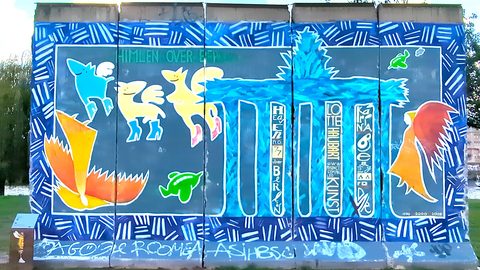
The death strip was a 155 km corridor of raked sand, dog lines, and armed patrols that surrounded West Berlin. After reunification, it became the most contested real estate in the city. Official demolition by GDR border troops began on 13 June 1990. By the end of that year approximately 184 km of inner city wall had been removed. The segments that survived did so by accident or by late intervention: the 1,316 m East Side Gallery at Mühlenstraße was saved because the artists painted on it before the demolition crews arrived. The 60 m Bernauer Straße section was preserved as a memorial after a long campaign. The 200 m stretch at Niederkirchnerstraße stayed because it backed onto government buildings. The rest was crushed, sold as scrap, or buried under new construction.
What Became Of The Border Crossings
The border crossings between East and West Berlin became obsolete at midnight on 3 October. Checkpoint Charlie was dismantled by the end of 1990; the replica you see today was erected on 13 August 2000, a decade later, as a commercial tourist attraction. The Oberbaumbrücke crossing, once the U-Bahn bridge for line U1 between Warschauer Straße and Schlesisches Tor, reopened without checks on 4 October. The Bösebrücke at Bornholmer Straße, where the first crossing opened on 9 November 1989, became a normal bridge again. The guard booths at the remaining crossings were sold at auction. The death strip at Potsdamer Platz, a 60 hectare wasteland, remained empty until 1994, when construction began on what would become Europe's largest building site.
Berlin Wall Demolition Timeline: What Was Gone by the End of 1990
The Berlin Wall demolition timeline is misremembered as a gradual process, but the critical period was June to December 1990. GDR border troops began official dismantling on 13 June 1990, before reunification. By 3 October, the Wall in the city centre was already breached in dozens of places. The sections that remained were removed between October and December 1990, when the legal protection of the frontier installations evaporated along with the GDR itself. The longest surviving segment is the East Side Gallery at 1,316 m. The Wall at Bernauer Straße is 60 m. The segment at Liesenstraße is approximately 30 m. The six segments at Potsdamer Platz, totalling about 15 m, were relocated in 2008. The Mauerweg, a 160 km trail following the Wall's former path, was completed in 2006 and is your best tool for finding the fragments.
How To See What Is Left
The double cobblestone line that marks the Wall's path is easy to miss. Get the Mauerweg map from the Berliner Verkehrsbetriebe ticket offices or download it before you arrive. The Bernauer Straße memorial is the only place in the city that preserves an intact death strip. The East Side Gallery is the longest section but heavily touristed; arrive before 09:00 to avoid the crowd. The Niederkirchnerstraße segment is visible from the street and free. The Potsdamer Platz segments are relocated and surrounded by corporate buildings, so they lack context. Skip those unless you are already at the Sony Center.
1990 Berlin City Changes: the Transport, the Telephone, and the Police
The 1990 Berlin city changes that mattered to daily life were in the infrastructure. The East Berlin public transport operator VEB Kombinat Berliner Verkehrsbetriebe (BVB) and the West Berlin Berliner Verkehrsbetriebe (BVG) remained separate legally until 1 January 1992 and operationaly until 1993. The S-Bahn was even more complicated: the East was run by Deutsche Reichsbahn (DR) and the West by BVG until 1 January 1994, when Deutsche Bahn AG took over both. Ride the S-Bahn from Alexanderplatz to Zoologischer Garten in October 1990 and you switch from a DR train to a BVG train at the former border station. Your ticket is valid on one side only. The BVG ticket validation system, with the small red boxes on platforms, was inherited from the West Berlin system. Forget to stamp it and the €60 fine applies, a rule that dates from the post reunification harmonisation of fare enforcement.
Telephone And Police Unification
The East Berlin telephone network was operated by Deutsche Post der DDR until 1 July 1991. The West used Deutsche Bundespost. Full technical integration of the exchanges was not completed until 1997. Call from Prenzlauer Berg to Kreuzberg in October 1990 and the call routes through two separate national phone companies. The Volkspolizei became Polizei Berlin on 3 October 1990, but in practice the East Berlin officers kept their uniforms and equipment until new ones were issued in 1991. The first all Berlin election was held on 2 December 1990, and Eberhard Diepgen of the CDU took office as the first all Berlin governing mayor on 24 January 1991.

Potsdamer Platz and the Club Scene: What Opened in the First Weeks
Potsdamer Platz in October 1990 was a 60 hectare wasteland. The Wall had bisected it, the death strip had sterilised the soil, and the buildings that stood before the war were rubble. It stayed empty until 1994, when construction began. The red container on stilts, the Info Box, opened in 1995 and stayed until 2001. The Daimler Benz quarter was completed in 1998, the Sony Center in 2000. For the first four years after reunification, Potsdamer Platz was a dust bowl. Cross it on foot on a dirt path.
The Clubs That Opened In The First Wave
Tresor opened on 13 March 1991 in the vault of the former Wertheim department store at Leipziger Straße 126. The building was razed in 2005. Tresor reopened at Kraftwerk Berlin in 2007. WMF opened in 1991 at Leipziger Straße 35 and closed in 1999. E Werk opened in 1993 at Wilhelmstraße 43 in a former electrical substation and closed in 1997. The Bunker at Reinhardtstraße 20 opened as a club in 1992 and closed in 1996. The original Tresor vault had one bar, a concrete floor, and a sound system that cost more than the rent. It was not a venue designed for comfort. It was a venue designed for techno in a space that had held bank safe deposit boxes.
Who Berlin Reunification 1990 Suits and Who it Does Not
Berlin reunification from 3 October 1990 suits Cold War history obsessives who want the exact date the Volkspolizei became Polizei Berlin; urban explorers who want to trace the Mauerweg through the remaining fragments; and travellers who prefer a story told in wastelands, repurposed bunkers, and the double cobblestone line over a tidy museum diorama. It does not suit anyone looking for a single monument or a walking trail that connects cleanly. The Wall was mostly gone by the end of 1990. Finding it is a scavenger hunt across 160 km of cobblestone lines, memorial sections, and gaps where you must imagine what stood. The most common mistake is trying to walk the Wall as if it were a continuous path. It is not. Bring the Mauerweg map, budget for a prepaid eSIM to navigate between fragments, and accept that several key buildings from October 1990, including the original Tresor vault and the WMF site, are now luxury apartments or hotels.
Read next
-
 East Side Gallery
-
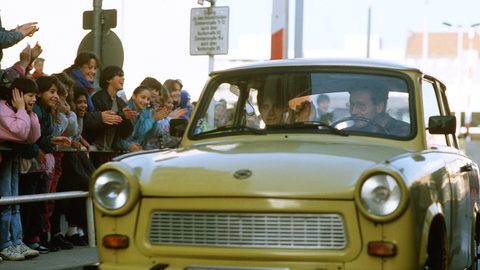 Checkpoint Charlie
The guardhouse at Checkpoint Charlie is a replica from 2000. Here is what is original Cold War fabric, what is a set, and where the real booth ended up.
Checkpoint Charlie
The guardhouse at Checkpoint Charlie is a replica from 2000. Here is what is original Cold War fabric, what is a set, and where the real booth ended up.
-
 Charlottenburg
-
 Mitte
Mitte
-
 Prenzlauer Berg
-
 Friedrichshain
-
 Neukölln
-
 Kreuzberg
-
 Berlin 1990s Films Run Lola Run Sun Alley and Berlin Babylon What They Captured
Run Lola Run, Sun Alley, and Berlin Babylon each captured a different Berlin of the 1990s — the first a sprint through the post-Wall city, the last a techno-scored documentary of its construction.
Berlin 1990s Films Run Lola Run Sun Alley and Berlin Babylon What They Captured
Run Lola Run, Sun Alley, and Berlin Babylon each captured a different Berlin of the 1990s — the first a sprint through the post-Wall city, the last a techno-scored documentary of its construction.