Charlottenburg: The Berlin Centre That Stopped Being a Centre in 1990
- Flag
-

- ISO code
- DE
- Currency
- EUR
- Timezone
- Europe/Berlin
Bahnhof Zoo at 08:30 on a Tuesday
At 08:30 on a Tuesday, Bahnhof Zoologischer Garten still moves like a centre. The S7 pulls in from Potsdam. The U9 dumps commuters onto Hardenbergplatz. The currywurst kiosk under the concrete canopy does a steady trade. Look east from the platform and you can see the top of the Funkturm, the radio tower that was West Berlin's skyline signature. But look at the departures board and the story shifts. Every regional train on the list goes through Berlin Hauptbahnhof now. The long-distance services that built this station's identity ended on 28 May 2006, the day Hauptbahnhof opened and Bahnhof Zoo became a regional stop. That is the moment this district's centrality broke. It never came back. Charlottenburg is the Berlin centre that stopped being one in 1990, and the station is where you feel it first.
West Berlin Zoologischer Garten Hub: What 100,000 Daily Passengers Looked Like
Between 1952 and 2006, Bahnhof Zoo was the main long-distance railway station for West Berlin. The numbers tell you what that meant. In 2019, the station still handled roughly 100,000 passengers a day, but that was after the long-distance traffic had been stripped out. In the 1980s, the count was higher, and every one of those passengers arrived on a train that had no alternative stop west of the Tiergarten. The S-Bahn here was the western hub of the entire city network. Lines S3, S5, S7, and S9 all crossed at Zoo. The U2 and U9 gave it a second layer of connectivity that no other West Berlin station matched.
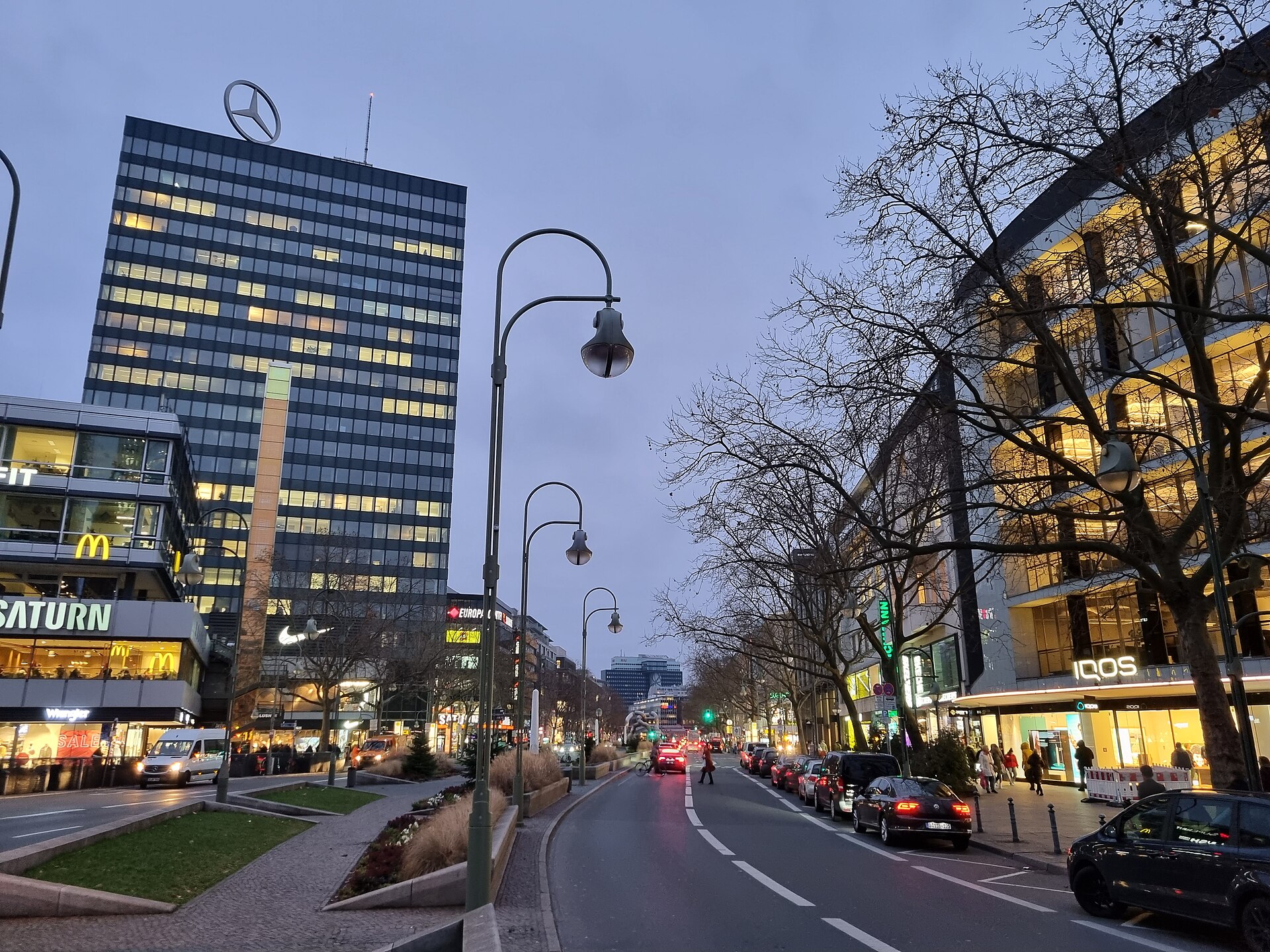
The geography made it inevitable. The Wall ran along the eastern edge of the Tiergarten, approximately 1.5 km east of Bahnhof Zoo. That left Zoo as the practical terminus for everything west of the border. The Kurfürstendamm, which starts a five-minute walk south of the station, was the primary commercial high street of West Berlin for those entire four decades. At 3.5 km long, it packed department stores, cafes, and cinemas into a corridor that had no eastern competitor. The KaDeWe, Kaufhaus des Westens, sat at the eastern end on Tauentzienstrasse with 60,000 m² of floor area and a founding year of 1907 that predated the division. It was the largest department store in continental Europe and it belonged to this side.
The Europa-Center, opened in 1965, added a 103-metre tower and a shopping complex that felt like West Berlin's answer to everything East Berlin could not build. The Kaiser Wilhelm Memorial Church, a ruin preserved as a war memorial, anchored Breitscheidplatz with a visual reminder of what the city had survived. For anyone arriving in Berlin from the west, Zoo was the front door. Charlottenburg was the room you walked into.
_1.jpg)
Berlin Charlottenburg Post-Reunification Decline: the Centre Slides East
On 9 November 1989, the Wall opened. On 3 October 1990, Germany reunified. Charlottenburg did not fall into ruin in those months, but its reason for being vanished overnight. The centre of Berlin had been locked in the east, in Mitte, behind the Wall for 28 years. Once the border crossings opened, the gravitational pull of the city shifted eastward with a force that surprised even Berliners. The S-Bahn time from Bahnhof Zoo to Alexanderplatz is roughly 12 minutes. That is how close the two centres are. Twelve minutes is the entire distance between the old West Berlin hub and the old East Berlin hub. When you can cover that gap in the time it takes to drink a coffee at the Zoo station kiosk, the idea of two separate urban centres collapses.
The Construction Boom That Redrew The Map
Potsdamer Platz, about 2 km east of Bahnhof Zoo, became Europe's largest construction site between 1994 and 2002. The Sony Center opened on 14 June 2000. The government ribbon moved to Mitte, with the Reichstag and the new chancellery pulling political gravity east. Friedrichstrasse and Hackescher Markt in Mitte took over as the city's shopping and dining corridors. The Kurfürstendamm did not empty, but it lost its primacy. The street that had been the window display of the West became a place you visited on a Tuesday afternoon when the Mitte crowds felt too dense.
The Numbers That Show The Shift
The regional train RE7 runs from Bahnhof Zoo through Mitte to the eastern districts. In the 1980s, that train would have been a local service within a single city half. After 1990, it became a corridor across a reconnected city, and the traffic flowed both ways. But the direction that mattered was eastward. Developers, retailers, and club promoters all followed the same logic: Mitte was where the empty lots were, where the rents were lower, and where the 1990s energy was concentrated. Charlottenburg had no empty lots. It had solid Wilhelminian blocks, maintained parks, and a population that was older and wealthier than the eastern districts. That stability became its disadvantage. The city's post-Wall dynamite went off in Mitte, Friedrichshain, and Prenzlauer Berg. Charlottenburg stayed intact and got left behind.
Kurfürstendamm Shopping Street Shift: from Window of the West to Second Tier
Walk the Kurfürstendamm today and you see the shift in real time. The block between Uhlandstrasse and Adenauerplatz still has the flagship stores, but the foot traffic thins noticeably after lunch. The real crowd is on Friedrichstrasse in Mitte, where the Galeries Lafayette and the Quartier 206 pull the spending that used to land on Tauentzienstrasse. The KaDeWe still draws its own crowd, and it should: 60,000 m² of retail on seven floors is a destination, not a neighbourhood shop. But the KaDeWe is on Tauentzienstrasse, not on the Ku'damm itself. Its address is Tauentzienstrasse 21-24, which places it at the eastern edge of Charlottenburg, almost at the Tiergarten. It functions as a hinge between the old west and the new centre, not as the anchor of a West Berlin commercial district.
The shift is not a failure. Charlottenburg is still wealthy. The residential streets north of the Ku'damm, around Savignyplatz, are among the most expensive in Berlin. The S-Bahn stop at Savignyplatz, served by lines S3, S5, S7 and S9, sits in a pocket of intact Wilhelminian fabric that survived the war and the post-war reconstruction. The Theater des Westens on Kantstrasse, opened in 1896, still runs musicals to full houses. The Stilwerk design centre at Kantstrasse 17, converted from a former power substation in 1999, still sells high-end furniture. These are not signs of decline. They are signs of a district that stopped being the centre and became a wealthy neighbourhood instead. If you are a first-time visitor to Berlin looking for a fairy-tale old town, Charlottenburg will not give it to you. What it gives you is a functioning, comfortable, slightly sleepy western district that had its peak in a different century.
Berlin Zoo Station vs Alexanderplatz: the 12-Minute Rivalry
Compare Bahnhof Zoo and Alexanderplatz on a map and the contest looks absurd. The distance is roughly 3.5 km from Zoo to the Brandenburg Gate, and another 1.5 km east to Alexanderplatz. The S-Bahn covers it in about 12 minutes. The U2 does it in 15. That is the entire difference between the two centres of Cold War Berlin, a gap so small that a fit person could walk it in 40 minutes. But for 28 years, that 12-minute gap was an international border with watchtowers, minefields, and armed guards. The Tiergarten, 210 hectares of park that had been a single recreational space before the war, was bisected by the Wall along its eastern edge. The Straße des 17. Juni, which continues Unter den Linden west through the Tiergarten to Ernst-Reuter-Platz, was renamed in 1953 to commemorate the East German uprising, but it led to a dead end at the Brandenburg Gate.
After 1990, the 12-minute S-Bahn ride became the city's most consequential journey. Alexanderplatz, which had been the showpiece transport hub of East Berlin, absorbed the traffic that used to terminate at Zoo. The U5 extension connected Hauptbahnhof to Alexanderplatz in 2020, further consolidating the eastern shift. Zoo kept its regional trains, the RE7 still serves it, but the long-distance services that made it a national station went to Hauptbahnhof. The S-Bahn western hub that Zoo had been became a local interchange. The eastern hub, Alexanderplatz, became the city's de facto centre, and the numbers in the guidebooks followed. A visitor arriving at Berlin Brandenburg airport takes the RE7, RB14, or S9 to Alexanderplatz in 30 to 35 minutes on a single ticket for €4.40. The same visitor would take 40 minutes to reach Zoo with a transfer. The infrastructure itself has been rewritten to favour the east.
Charlottenburg 1990s Club Absence: Why the Techno Wave Skipped This District
Ask a Berlin club pilgrim where the 1990s techno scene lived and the answers are all east of the Tiergarten. Tresor opened in 1991 in the vault of a former Wertheim department store at Leipziger Strasse 126 in Mitte, about 4 km east of Bahnhof Zoo. The RAW Gelände in Friedrichshain, the abandoned railway repair works, became a club birthplace that still breathes. The Wasserturm in Prenzlauer Berg, a former water tower that was Berlin's first concentration camp and later a squat, became a live music and club venue. Tacheles, the squatted art house on Oranienburger Strasse in Mitte, ran parties in its ruined shell until the building was partially demolished in 2012. Charlottenburg had none of this.
Why The East Had The Spaces
The reason is structural. Charlottenburg's building stock in 1990 was largely intact, privately owned, and occupied. The empty lots and abandoned industrial spaces that defined the 1990s club wave existed in the east, where the GDR had left entire blocks unmaintained for four decades. The squat wave that turned Prenzlauer Berg's crumbling tenements into artists' colonies and the club wave that turned Friedrichshain's repair works into dance floors both depended on spaces that were available because nobody else wanted them. Charlottenburg had no such spaces.
Trade Fairs Instead Of Dance Floors
The Messe Berlin trade fair complex, with its 1937 exhibition halls and the Funkturm, drew a different crowd: business travellers, conference attendees, and the visitors to the ITB Berlin in March and IFA in September. Those trade fairs spike hotel prices citywide, but they do not bring club culture. The ICC Berlin, the massive conference centre that opened in 1979, has been closed for renovation since 2014 with no confirmed reopening date. Its absence symbolises the district's post-1990s trajectory: a trade fair and hotel spike that comes and goes, leaving the residential streets quiet.
The Loveparade did route through the Kurfürstendamm in 1996, drawing roughly 750,000 attendees from Wittenbergplatz to Ernst-Reuter-Platz. The 1997 edition drew roughly 1,000,000. But the Loveparade was a single-day event on a parade route, not a permanent club scene. When the parade moved to the Ruhr region in 2007 after permit and funding disputes, Charlottenburg lost even that annual injection of techno energy. The district's last Berlin edition was 2006, and the crowds went with it. Today, the 1990s club and squat legacy that drives so much of Berlin's tourism is concentrated in Friedrichshain, Kreuzberg, and the edges of Mitte. Charlottenburg has the KaDeWe, the palace, and the museums. It does not have a single 1990s techno venue of equivalent scale. That absence shapes the kind of traveller who belongs here and the kind who should spend their time east of the Tiergarten.
What Charlottenburg Still Does Better Than the East
For all that Charlottenburg lost its centrality, it kept assets that the eastern districts cannot match. The Charlottenburg Palace, built between 1695 and 1713 and expanded in the 1740s, is a Baroque palace with a 55-hectare park that puts the eastern palaces in Potsdam to shame for convenience. The Bröhan Museum, opened in 1983, holds a focused collection of Art Nouveau, Art Deco, and Berlin Secession works in a building at Schloßstrasse 1a. The Berggruen Museum, opened in 1996 at Schloßstrasse 1, has Picassos, Klees, Matisses, and Giacomettis that would be the centrepiece of any other city's museum landscape. The Sammlung Scharf-Gerstenberg, opened in 2008 at Schloßstrasse 70, covers Surrealist and pre-Surrealist art. Three museums on one street within a five-minute walk of each other is a density that even Museum Island in Mitte cannot match for variety.
Photography, Theatre, And Open-Air Stages
The C/O Berlin photography centre, located in the former Amerikahaus at Hardenbergstrasse 22-24, opened in this location in 2014 and runs rotating exhibitions that pull photographers from across Europe. The Museum für Fotografie at Jebensstrasse 2, housed in a former Prussian officers' mess built in 1909, opened in 2004 and contains the Helmut Newton Foundation. Newton's estate, with its sharp black-and-white fashion photography, fits the district's aesthetic: refined, slightly decadent, and completely uninterested in the raw concrete of the east. The Theater des Westens on Kantstrasse runs big musicals. The Waldbühne, a 22,290-capacity outdoor amphitheatre built in 1936 and renamed in 1948, hosts concerts through the summer months. The Olympiastadion, renovated between 2000 and 2004 for the 2006 World Cup, seats 74,475 and draws international sporting events. Charlottenburg is not dead. It is just not the centre anymore.
The Walk That Proves The Geography
Stand at the Kaiser Wilhelm Memorial Church on Breitscheidplatz. Walk east along Tauentzienstrasse past the Europa Center. Cross the Straße des 17. Juni and enter the Tiergarten. Walk east through the park for roughly 20 minutes and you emerge at the Brandenburg Gate. You have crossed from the old West Berlin centre to the old East Berlin centre on foot in the time it takes to eat a lunch. The Tiergarten paths that were severed by the Wall have been reconnected, and the memorials along the eastern edge mark where the death strip ran. The city-wide compression that happened after 1990 is not a theory. It is a walk you can do in under half an hour. That walk is the whole story of Charlottenburg's post-1990 trajectory: geographically central, functionally peripheral, and impossible to understand without crossing the park.

The Practical Reality of Visiting Charlottenburg in 2026
Arrive at Bahnhof Zoo on the S-Bahn and you step into a station that serves roughly 100,000 passengers a day but feels like a regional stop. The RE7 stops here, and the S3, S5, S7 and S9 all pass through, but the station's scale is out of proportion to its current function. The platforms are wide enough for the long-distance trains that no longer stop. The concourse is quiet compared to Hauptbahnhof or Alexanderplatz. Book a hotel near Zoo if you want access to the western rail interchange and the U2 and U9 lines, but budget for the journey to Mitte every time you leave the district. The 12-minute S-Bahn ride to Alexanderplatz adds up over three days. If your trip is built around the 1990s club legacy, the East Side Gallery, the RAW Gelände, and the Wasserturm, staying in Friedrichshain or Kreuzberg saves you that cumulative transit time.
Cash is still mandatory in many 1990s holdover bars and Imbisse in Charlottenburg, just as it is in the eastern districts. The BVG public Wi-Fi at U-Bahn stations requires a one-time SMS verification that fails with a foreign phone number. Get a local SIM from Aldi Talk for €10. It solves the problem. The free Wi-Fi in the former east is patchy, but Charlottenburg's cafes tend to have better coverage. The honour-based ticket system on the U-Bahn and S-Bahn is enforced by plainclothes inspectors who issue €60 fines on the spot, no excuses accepted. Validate your BVG ticket before boarding and keep it visible until you exit. The friction points of Berlin's transport system apply equally across all districts, but the consequences of ignoring them are the same in Charlottenburg as they are in Friedrichshain.
Charlottenburg is for Second-Time Visitors and Cold War History Completers
Charlottenburg suits the traveller who has already done the greatest hits of Berlin and wants the layer underneath. Cold War history completists will find the story of West Berlin's lost centre more revealing than the preserved Wall segments at Bernauer Strasse or the East Side Gallery, precisely because it requires walking the geography to understand it. Urban exploration and architecture nerds will find the contrast between the Wilhelminian fabric of Savignyplatz, the post-war modernism of Ernst-Reuter-Platz, and the 1990s corporate insertions at Ludwig Erhard Haus worth a dedicated afternoon. That building, Nicholas Grimshaw's 1998 work that now houses the Berlin Chamber of Commerce and Industry, is a landmark of the period. Photographers chasing post-industrial decay will find more material in the east, but photographers chasing the specific texture of a wealthy western district that stopped being the centre will find Charlottenburg's quiet boulevards and slightly dated shopfronts a different kind of subject.
First-time Germany visitors wanting a fairy-tale old town should skip Charlottenburg entirely. Berlin's 1990s layer is deliberately broken, sprawling, and emotionally heavy, and Charlottenburg is not the place to start with it. Visitors with three minimum days should spend one on the Wall's scattered remains, one on the 1990s club and squat legacy in the eastern districts, and one on the wasteland-to-park transformations in Treptow and Wedding. Give Charlottenburg half a day on the second visit, not the first. The peak season of May to September delivers open-air techno parties and street festivals in the east, not in Charlottenburg. The major trade fairs of ITB Berlin in March and IFA in September spike hotel prices citywide, and Charlottenburg's hotels near Messe Berlin feel the spike hardest. November 9 crowds at Wall sites are dense and ceremonial rather than explorable. Plan around those windows, or accept the crowds and the prices. Charlottenburg will still be here, 12 minutes from Alexanderplatz, quiet and wealthy and no longer the centre.
| Feature | Charlottenburg | Friedrichshain / Kreuzberg / Mitte |
|---|---|---|
| 1990s techno club origin | None | Tresor, RAW-Gelände, Wasserturm |
| Wall remnants in district | None (nearest at Bernauer Straße, 6 km northeast) | East Side Gallery, Berlin Wall Memorial |
| Squat legacy | Minimal | Prenzlauer Berg, Tacheles, Friedrichshain |
| S-Bahn time to Alexanderplatz | 12 min (Zoo) | 5–15 min depending on station |
| Primary 1990s draw | Cold War geography of lost centre | Club shells, street art, vacant lot parks |
Common Questions
How far is Bahnhof Zoo from Alexanderplatz?
Roughly 3.5 km. The S-Bahn covers it in about 12 minutes. The U2 does it in 15. You can walk it in 40 minutes through the Tiergarten.
When did Bahnhof Zoo stop being a long-distance station?
28 May 2006, the day Berlin Hauptbahnhof opened. Zoo had been the main long-distance railway station for West Berlin since 1952.
What caused the Kurfürstendamm to lose its primacy?
Reunification. Friedrichstrasse and Hackescher Markt in Mitte became the city's shopping and dining corridors after 1990.
Is there any 1990s techno club still running in Charlottenburg?
No. The 1990s club wave concentrated in Mitte, Friedrichshain, and Kreuzberg. Tresor, the defining venue, was 4 km east of Bahnhof Zoo. Charlottenburg had no venue of equivalent scale.
Why did the 1990s squat and club wave skip Charlottenburg?
Charlottenburg's building stock was intact, privately owned, and occupied in 1990. The empty lots and abandoned industrial spaces that fuelled the squat and club wave existed in the former East Berlin districts.
What museums in Charlottenburg are worth a dedicated trip?
The Berggruen Museum (Picasso, Klee, Matisse, Giacometti), the Bröhan Museum (Art Nouveau, Art Deco, Berlin Secession), and the Sammlung Scharf-Gerstenberg (Surrealist art) are all on Schloßstrasse within a five-minute walk of each other.
Should first-time Berlin visitors stay in Charlottenburg?
No. The 1990s club and squat legacy, the East Side Gallery, and the RAW-Gelände are all east of the Tiergarten. Book a hotel in Friedrichshain or Kreuzberg to save cumulative transit time.