Mitte: The Empty Middle of Berlin That Became the Most Expensive Addresses
- Flag
-

- ISO code
- DE
- Currency
- EUR
- Timezone
- Europe/Berlin
The Empty Middle That Became the Priciest Square Footage in Berlin
You are standing on Bernauer Strasse, and the city is not where you expect it to be. A 1.4 km corridor of open ground, scrub grass, and a rusted watchtower runs through the middle of Berlin. This was the death strip. The Wall is gone from most of it. What remains is a void 100 to 200 metres wide, preserved as the Berlin Wall Memorial. Understand this physical fact before you spend a single euro in Mitte: the borough's western edge was sliced open in 1961, left as a 43 km corridor of no-man's-land, and then, after 1989, became the most valuable dirt in Germany. The story of Mitte Berlin's empty middle and its most expensive addresses is the story of how a wound became a real estate play, and how the scars of that transformation are still visible if you know where to look.
Berlin Mitte Wall Fragments: Where to Find What is Left
Bernauer Strasse: The Last Complete Section
The Wall did not disappear cleanly. It shattered into fragments across four districts. In Mitte, the most coherent section is on Bernauer Strasse, between Nordbahnhof and Schwedter Strasse. This is the last remaining complete Wall section with the death strip attached. You can still see the inner wall, the outer wall, and the patrol road between them. The strip is free to view. The memorial visitor centre at the north end explains what you are looking at: a continuous void that ran from the south edge of Wedding through the centre of Mitte to the north edge of Kreuzberg. The width averaged 150 to 300 metres. On Bernauer Strasse, it reached its fullest expression.
Nordbahnhof was a ghost station from 1961 to 1989. Trains passed through without stopping. The station reopened in 1990, and you can still feel the dimension of the no-man's-land when you exit: the distance from the S-Bahn platform to the first East Berlin building is roughly the width of a football pitch. That gap is the death strip.
Scattered Remains Across the District
Other fragments are scattered. Look for the double row of cobblestones in the street surface that marks the Wall's line. A bronze plaque on Friedrichstrasse at the Checkpoint Charlie crossing tells you where the border booth stood. None of it is continuous. The single most common mistake visitors make is assuming the Wall is a visitable monument. It is a dispersed trail of fragments, memorials, and absences that demands a planned route across four districts. Budget one full day for the scattered remains.
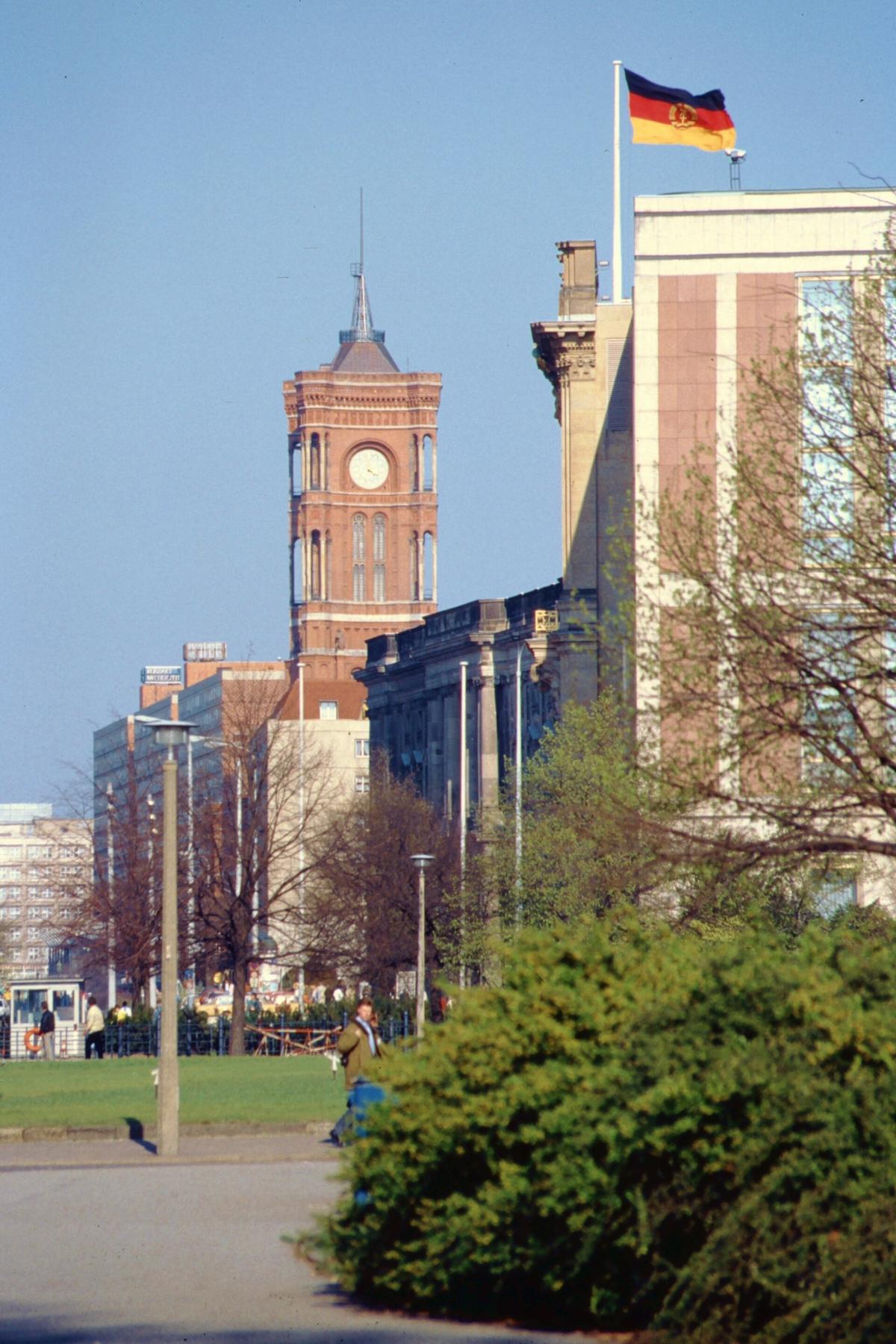
_a.jpg)
Bernauer Strasse Memorial Site: the Death Strip Preserved
The Preserved Strip
Start at the Berlin Wall Memorial on Bernauer Strasse. The preserved strip is 1.4 km long and runs from the corner of Brunnenstrasse north to Schwedter Strasse. Enter at the visitor centre and walk south. The chapel of reconciliation sits on the former death strip, built on the site of the church that was blown up in 1985 because it was in the field of fire. The memorial includes a documentation centre, an outdoor exhibition, and a section of the original border fortifications with watchtower. Arrive before 10:00 to avoid the school groups. The site is free.
Mauerpark and the Void
South of the memorial, the death strip corridor becomes Mauerpark. This is the former border strip between Wedding in the West and Prenzlauer Berg in the East. Mauerpark opened in 1994. On Sundays, the flea market fills the park, and the karaoke pit at the amphitheatre draws crowds from 15:00. The karaoke started in 2009 and has become a ritual. Skip the park on Monday; it is empty and the market is gone.
The death strip along this street was roughly 100 to 200 metres wide. Today, that gap is a mix of memorial, park, and new residential blocks. The void is still legible. Stand at the corner of Bernauer Strasse and Brunnenstrasse and look north: the buildings on the west side are 1990s infill. The buildings on the east side are pre-war tenements. The space between them is the scar.
Checkpoint Charlie Tourist Site: the Replica and What it Costs You
Checkpoint Charlie is the most visited Cold War site in Berlin and the least satisfying. The replica guardhouse on Friedrichstrasse at Zimmerstrasse is a reconstruction. The original was removed in 1990. A group of actors in replica US military uniforms will charge you for a photo. The site is free to view; paying for the photo is your choice. Skip the museum across the street unless you have two hours for a dense, opinionated collection that has not been updated since the 1990s. The real story is on the pavement: the double line of cobblestones marking the border, and the plaque that reads "You are leaving the American sector."
The street-level crossing hall, the Tränenpalast (Palace of Tears), is 300 metres north at Friedrichstrasse 17. This was the departure hall for West Berliners visiting the East. It is now a free museum on the grief of leaving, and it is better than any paid attraction at Checkpoint Charlie. The Tränenpalast is open Tuesday to Friday 09:00 to 19:00, weekends 10:00 to 18:00. Arrive early; it fills with school groups by 11:00.
Potsdamer Platz 1990s Construction: from Sand Pit to Corporate Canyon
From Wasteland to Building Site
Potsdamer Platz was Europe's busiest public square before the war, with five-star hotels, department stores, and the first traffic light in Germany from 1924. In 1990, it was 60 hectares of empty sand, grass, and derelict infrastructure. The Wall had run through it, leaving the entire square inside the death strip. The Brandenburg Gate, north of the square, was also in the death strip behind the eastern perimeter wall, inaccessible from 1961 to 1989.
From 1994 to 2002, Potsdamer Platz was Europe's largest building site. Up to 5,000 workers daily and over 40 tower cranes built a new city on the void. Total investment was roughly €10 billion. The result is a corporate canyon: the Sony Center, completed in 2000 by architect Helmut Jahn; the DB Tower at 103 metres, completed in 2000; Debis House by Renzo Piano, completed in 1997; and the Park Kolonnaden, completed in 2001. The Potsdamer Platz Arkaden mall opened in 1998. The S-Bahn and U-Bahn stations both reopened in 1992.
What Stands There Now
Walk to Marlene Dietrich Platz inside the Sony Center. The glass canopy is the architectural centrepiece. Office rents in the Sony Center run in a band published annually by the Berlin Gutachterausschuss; check the current figures before you go. One pre-war building survived: Weinhaus Huth, built in 1912, now a restaurant and Daimler AG event space at Potsdamer Strasse 3. Everything else is new.
The 1990s construction pit is gone. What remains is a corporate canyon that feels sterile. The grit of the 1990s has been curated out. If you want the 1990s feeling of vacant lots and raw concrete, skip Potsdamer Platz and head to RAW-Gelände in Friedrichshain.
Government Ribbon Berlin: the New Political Centre on the Death Strip
North of Potsdamer Platz, the government ribbon runs along the Spree bend. The Bundestag, the Chancellery, and the Bundesrat building on Leipziger Strasse occupy the former death strip. The Bundesrat moved into the former Prussian House of Lords in 2000. The entire government district sits on land that was a void in 1990. Walk from Potsdamer Platz north along the Spree to the Hauptbahnhof. You are walking on the death strip. The buildings on your left are post-1995. The buildings on your right were in West Berlin. The line between them is invisible now, but the open space where the Wall stood is still there, turned into parks and promenades.
The government ribbon is best seen from the Reichstag dome. Book online weeks ahead; the walk-in queue can exceed two hours in peak season. The dome is free. Arrive at 08:00 for the first slot and you will have the view to yourself until 09:30.
Tacheles: the Squat That Made Mitte Famous and the Development That Replaced it
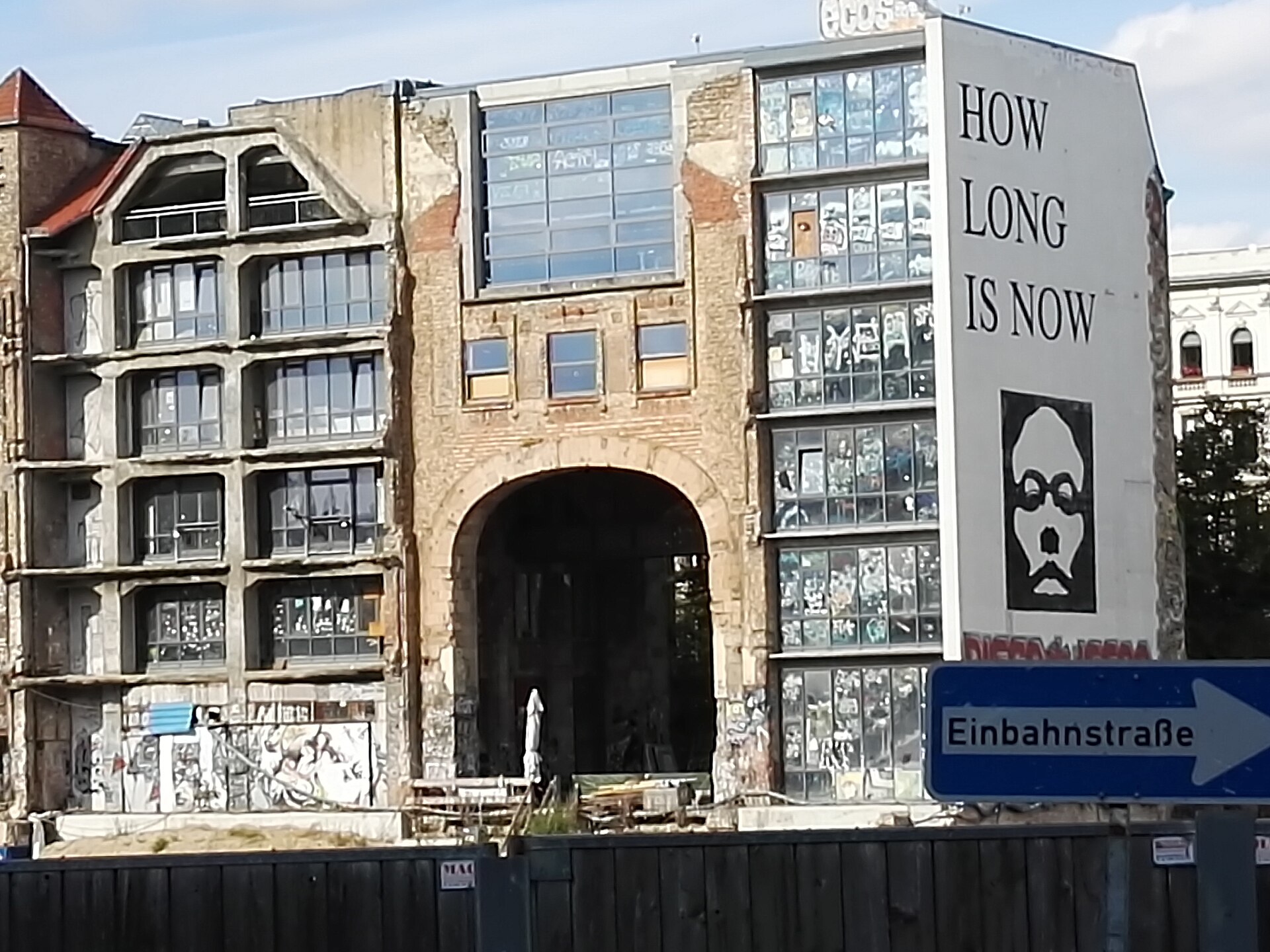
Tacheles at Oranienburger Strasse 54-56a was the symbol of 1990s Mitte. The building was the Friedrichstrassenpassage, built 1907-1908, damaged in the war, used by GDR trade organisations, and slated for demolition in 1989. On 13 February 1990, an artists' initiative occupied the building. It operated as a studio, club, and bar until 2013. Café Zapata in the ground floor courtyard was the social centre. The Globus club in the rear courtyard hosted techno parties. Dschungel club on Oranienburger Strasse ran from 1991 to 1993. Tacheles was evicted on 4 September 2012. The rear sections were demolished in 2013. The front building was preserved and integrated into a new mixed-use complex called Am Tacheles, which opened in 2023. Residential prices in the new development run in a band depending on fit-out and floor; the current figure is published by the Gutachterausschuss. The street art remnant on the front facade is all that remains of the squat.
Oranienburger Strasse in the mid-1990s was lined with squat bars, clubs, galleries, and semi-derelict courtyards. The Neue Synagoge at number 28-30, built 1859-1866, had its dome reconstructed in 1993. Today, the street is restored, with hotels and restaurants. The grit is gone. The only place you can still feel the 1990s is at the exterior of Tacheles, and it is a partial ruin.

Hackescher Markt and the Scheunenviertel: Where the 1990s Vacant Lots Became the Most Expensive Blocks
The Transformation of Hackescher Markt
Hackescher Markt in 1990 was pitted cobblestones, soot-blackened S-Bahn arches, derelict tenement blocks, and a patchwork of blown-out windows. The S-Bahn station had been there since 1882. The area was in East Berlin, roughly 1 km east of the Wall line. By 1993, the restoration of Hackesche Höfe had begun. The eight courtyards at Rosenthaler Strasse 40/41, built 1906-1907, were restored 1993-1996. Today they contain retail, offices, apartments, a cinema, and a theatre. Commercial rents run in a band published by the Gutachterausschuss; check current figures before you visit. The residential units number roughly 80. The restaurant seat density in the area is one of the highest in Berlin.
Scheunenviertel: From Squats to Square-Metre Prices
The Scheunenviertel, bounded by Oranienburger Strasse, Rosenthaler Strasse, Auguststrasse, and Hackescher Markt, was the centre of the 1990s vacant flats phenomenon. Blocks with indeterminate state ownership after the Treuhandanstalt dissolution at the end of 1994 and the collapse of communal housing companies left whole tenements empty. Squatters and low-rent artist collectives occupied the buildings. Rosenthaler Platz in 1992 was widespread vacant tenements, many occupied. Today, the same buildings sell in a price band published by the Gutachterausschuss. The 1990s infrastructure of squats and clubs is now private or demolished. You are often looking at a plaque or a replacement building.
Clärchens Ballhaus at Auguststrasse 24 opened in 1913. In the 1990s it was still operating, unreconstructed, with a worn dance floor. It closed for restoration in 2020 and reopened in 2023. The dance floor is new. The soul is intact. Book a table for the Sunday afternoon tango session if you want the 1990s feel without the grit.
The 1990s Club Scene That Shaped Mitte and Where Its Ghosts Still Breathe
The Clubs That Defined the Decade
The 1990s club scene in Mitte was built on vacant spaces. Tresor opened in 1991 in the vaults of the former Wertheim department store at Leipziger Strasse 126-128, directly on the Potsdamer Platz death strip. It closed on 16 April 2005 and reopened in 2007 at Köpenicker Strasse 70 in the Kraftwerk plant on the Mitte/Kreuzberg edge. The original Wertheim vault site is now redeveloped as part of the Potsdamer Platz extension. E-Werk at Wilhelmstrasse 43, a former electrical substation with a vast turbine hall, opened in 1993 and closed in 1997; it is now an event venue. Bunker Mitte at Reinhardtstrasse 20, built in 1943 as an air-raid shelter, became a techno club in the 1990s, then closed in 2002. It is now the Sammlung Boros private art collection, which requires a guided tour booked months ahead.
What Remains of the Scene
WMF club founded in 1991 in the Hackescher Markt area and moved across several Mitte addresses. KitKatClub founded in 1994 in a former squat near Friedrichstrasse and shifted venues. Loveparade started in 1989 with roughly 150 participants, peaked in 1999 at 1.5 million, and moved from Berlin in 2007. The Duisburg disaster on 24 July 2010 killed 21 people, and the parade was permanently cancelled. The 1990s club scene is not a walking tour. Most rooms are closed or converted. The ghosts are in the addresses: Wilhelmstrasse 43, Leipziger Strasse 126, Reinhardtstrasse 20. You are looking at replacement buildings.
What Mitte is Bad at and Who Should Skip it
Mitte is bad at being a walkable historic core. The Wall sliced through it, and the death strip corridor is now a mix of memorial, park, and new construction. You cannot follow a straight line from the Brandenburg Gate to Alexanderplatz without crossing the void. The 1990s building boom left a corporate canyon at Potsdamer Platz that feels sterile. The club scene is dead; most rooms are closed or converted. The street art that was everywhere in the 1990s is now curated and commercialised. First-time Germany visitors wanting a fairy-tale old town should skip Mitte. The 1990s layer is deliberately broken, sprawling, and emotionally heavy.
Who should come: Cold War history completists, 1990s techno and club-culture pilgrims, urban-exploration and architecture nerds, second-time Berlin visitors digging past the greatest hits, and photographers chasing post-industrial decay. Minimum three days: one for the Wall's scattered remains, one for the 1990s club and squat legacy, one for the wasteland-to-park transformations. Arrive at Berlin Brandenburg Airport, take the regional train RE7 or RB14 or the S-Bahn S9 to Alexanderplatz in 30-35 minutes. A single ticket costs what BVG publishes on its website; check before you travel. A taxi to Mitte runs roughly in a band from €50 to €60 depending on traffic. Get around on U-Bahn and S-Bahn with a BVG ticket validated before boarding. The honour-based system has plainclothes inspectors issuing €60 fines on the spot. No excuses accepted.
Mitte Berlin Empty Middle Most Expensive Addresses: What You Actually Do Next
Book the Berlin Wall Memorial visitor centre slot online for 09:00 on your first morning. Walk the 1.4 km preserved strip south from the visitor centre entrance on Bernauer Strasse to Schwedter Strasse. Cross into Mauerpark and check the flea market if it is Sunday. Take the U-Bahn from Eberswalder Strasse to Potsdamer Platz. Walk the corporate canyon: Sony Center, Marlene Dietrich Platz, Weinhaus Huth. Take the S-Bahn one stop to Brandenburger Tor and walk the government ribbon along the Spree. In the afternoon, head to Oranienburger Strasse. See the Tacheles exterior facade, the Neue Synagoge dome, and the Tränenpalast. Skip Checkpoint Charlie unless you have five minutes for the replica guardhouse. End at Clärchens Ballhaus on Auguststrasse for a beer on the worn dance floor that is now restored. That is your one-day Mitte: the empty middle that became the most expensive addresses, walked from north to south, from death strip to corporate canyon, from the preserved void to the filled-in scar.
Common Questions
Why is Mitte called the empty middle and what does that mean for visiting?
Mitte means middle in German. The Wall ran north-south through the western edge of the borough, leaving a 43 km death strip corridor that was a void of vacant lots, rubble, and no-man's-land from 1961 to 1989. After reunification, that void became the most expensive real estate in Berlin. For visitors, this means the historic centre is bisected by a corridor of new buildings, memorials, and parks. You cannot walk a continuous old town. The emptiness is built into the geography.
How much time should I budget for the Berlin Wall Memorial on Bernauer Strasse?
Two hours minimum. The outdoor memorial is 1.4 km long and free. The visitor centre, documentation centre, and chapel of reconciliation add another hour. Arrive before 10:00 to avoid school groups. The site is open daily 08:00 to 22:00, but the visitor centre closes at 18:00.
Is Checkpoint Charlie worth visiting?
The replica guardhouse is free to view and takes five minutes. The museum is a dense, opinionated collection that has not been updated since the 1990s. Skip it unless you have two hours for Cold War memorabilia. The Tränenpalast at Friedrichstrasse 17 is free and better. It covers the human experience of border crossing, not just the checkpoint.
What happened to the squat scene in Mitte?
Most squats were evicted or legalised by the early 2000s. Tacheles was evicted in 2012 and demolished except for the front facade. The site is now a mixed-use development with residential prices in a band published by the Gutachterausschuss. The 1990s club infrastructure at Bunker Mitte, E-Werk, and Tresor's original location is either converted to art spaces or replaced by new buildings. The grit is now curated.
Can I walk the entire Wall path through Mitte?
No. The Wall path through Mitte ran north-south separating Mitte from Tiergarten and Wedding, but the trail is fragmented. You can walk the 1.4 km memorial section on Bernauer Strasse, then take the S-Bahn from Nordbahnhof to Potsdamer Platz to see the corporate canyon, then take the U-Bahn to Checkpoint Charlie. The continuous route does not exist above ground.
What is the most expensive street in Mitte?
Oranienburger Strasse and the Scheunenviertel blocks around Auguststrasse and Rosenthaler Strasse command the highest residential prices; check the Gutachterausschuss for the current per-square-metre band. The Potsdamer Platz office corridor has commercial rents published annually by the same body. Both areas were vacant lots or derelict tenements in 1992.
When should I avoid Mitte?
Major trade fairs in March (ITB Berlin) and September (IFA) spike hotel prices citywide. November 9 brings dense crowds to Wall sites for the anniversary of the Wall's fall. Summer weekends from May to September are peak for open-air events and street festivals. If you want empty streets, visit January or February midweek.