Three 1990s Berlin Walking Routes That Connect the Post-Wall Fragments on Foot
Three walkable Berlin routes stitch the post-Wall 1990s together across Friedrichshain, Mitte, and Kreuzberg, with noted transit hops where the fragments are too far apart for a single walk.

Three 1990s Berlin Walking Routes That Connect the Post-Wall Fragments on Foot
Berlin's 1990s layer is scattered across four districts, not a single line. The Wall fragments, the club cellars, the vacant lots turned parks, the construction pits that became corporate canyons sit in Mitte, Friedrichshain, Kreuzberg, and Prenzlauer Berg with transit gaps between them. A continuous walk from the East Side Gallery to the Berlin Wall Memorial takes over an hour by foot and crosses a former death strip that is now a highway. You need a planned sequence. These three Berlin 1990s walking routes each cover one coherent stretch in a single morning or afternoon. The transit hop between them is stated plainly. The route names are real search terms. The walking times and station names are the ones you will use.
Post-Wall Berlin Walks: the Bernauer Strasse to Nordbahnhof Sequence
Start: U Bernauer Strasse (U8). End: S Nordbahnhof (S1, S2, S25, S26). Distance: 1.4 km. Time: 45 minutes to 1 hour.
The Death Strip Preserved
This is the most intact post-Wall Berlin walk for understanding what the death strip actually was. The Berlin Wall Memorial preserves a 200-metre segment of the double-layer Wall: the outer wall facing West Berlin and the hinterland wall on the East side. Between them runs the death strip, 30 to 100 metres wide. The patrol road, the sand strip raked for footprints, and the watchtower are all there. Stand where a border guard would have had a clear shot.
Walk the Wall Trail from U Bernauer Strasse north toward S Nordbahnhof. The trail runs along the former border. At Bernauer Strasse, the Chapel of Reconciliation marks the site of a church that stood in the death strip and was demolished in 1985. The Documentation Centre has a viewing platform that costs nothing. Go up it before you walk the trail. The aerial perspective makes the width of the cleared zone visible in a way ground level cannot.
The Ghost Station
Nordbahnhof was a ghost station from 1961 to 1989. During division it was called Zoll-/Grenzübergangsstelle, a GDR control point. Trains passed through without stopping. The station today shows original GDR signage in the preserved sections. Exit the station and you are at the northern edge of Mitte, ready for the next route.
Failure case: The memorial is free and open 24 hours, but the Documentation Centre and viewing platform close at 18:00 (20:00 in summer). Arrive by 15:00 if you want the platform. The outdoor trail is always accessible.
Berlin Cold War Urban Hike: the Mitte Fragment Trail
Start: S+U Alexanderplatz (S3, S5, S7, S9 / U2, U5, U8). End: S Nordbahnhof (S1, S2, S25, S26). Distance: 2.6 km. Time: 40 minutes to 1 hour.
From the Palace Void to the Tränenpalast
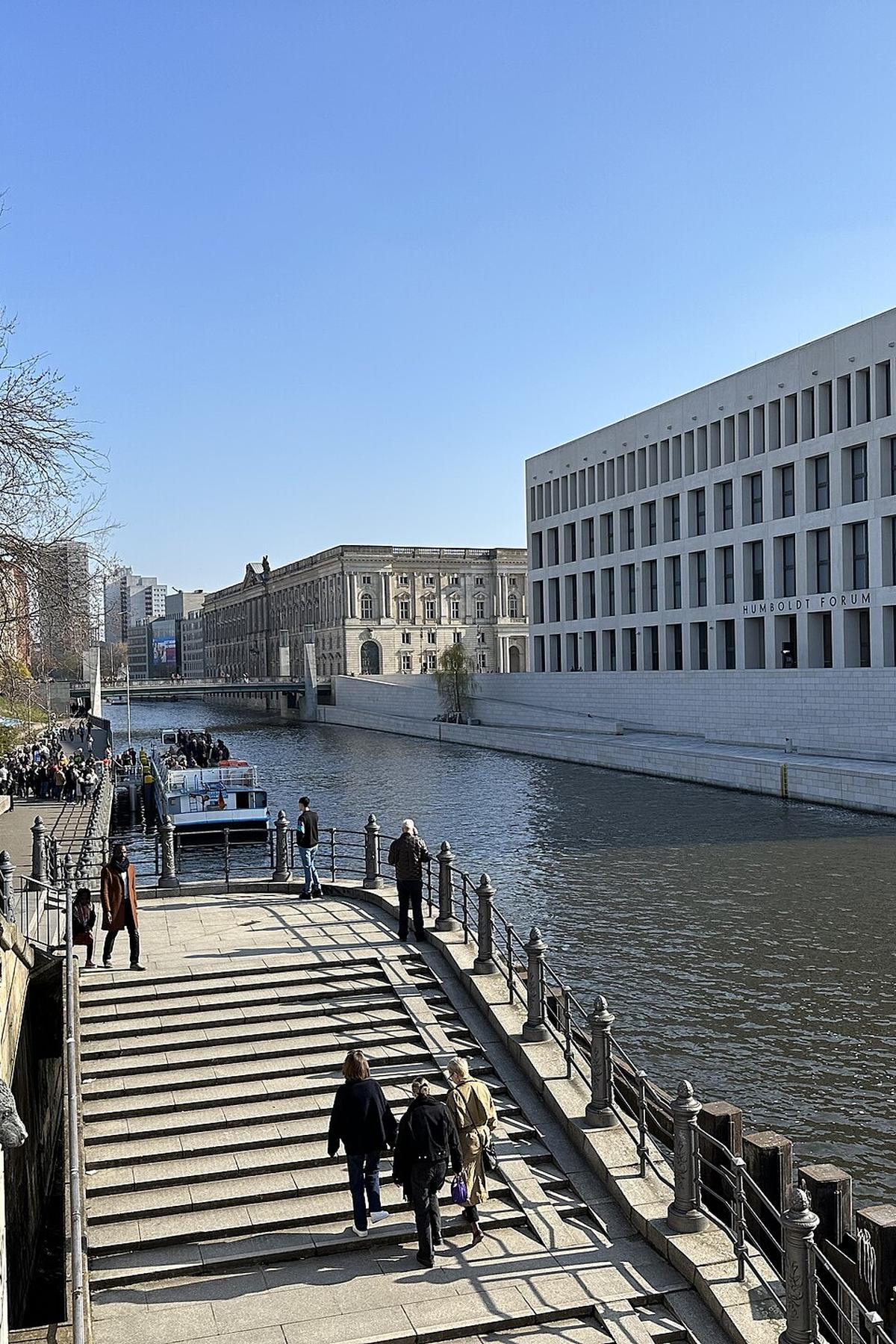
This Berlin Cold War urban hike connects the government-ribbon reconstruction of Mitte with the few Wall fragments that survived the 1990s building boom. From Alexanderplatz, walk west along Karl-Liebknecht-Strasse. At the Spree, the empty space where the Palace of the Republic stood until 2008 is not a 1990s site. The recreated Stadtschloss that replaced it is a symbol of the decade's debates over what to keep and what to erase.
Continue to the Tränenpalast at Friedrichstrasse station. This former border crossing hall is now a free museum on the grief of departure: East Berliners saying goodbye to visitors from the West. Allow 30 minutes inside. The exhibits focus on 1961 to 1989, but the building itself is a 1990s artefact, preserved when the crossing was decommissioned.
The Rail Yard Fragment and Transit Hop
From Friedrichstrasse, walk north to the Wall fragment at Invalidenstrasse, a 30-metre unpainted section behind a fence. It is easy to miss. It marks where the border ran through a working rail yard. Continue to S Nordbahnhof, the end of this route and the start of the Bernauer Strasse walk if you reverse it.
Transit hop: From S Nordbahnhof to U Bernauer Strasse is one stop on the S1 or S2, or a 15-minute walk. The S-Bahn hop costs a single BVG ticket, validated before boarding. Plainclothes inspectors issue fines on the spot for unvalidated tickets. Check the current BVG penalty tariff before you travel.
1990s Club District Walking Tour: Warschauer Strasse to RAW-Gelände
Start: S+U Warschauer Strasse (S3, S5, S7, S9 / U1, U3). End: U Samariterstrasse (U5). Distance: 2.3 km. Time: 35 to 50 minutes.
The East Side Gallery
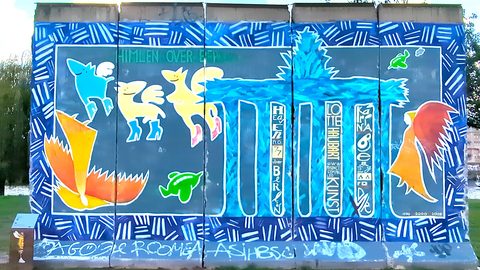
This 1990s club district walking tour covers the Friedrichshain corridor where Berlin's post-Wall nightlife was born. From Warschauer Strasse station, cross the Oberbaumbrücke. The bridge itself is a 1990s rebuild, reopened in 1995 after being a border crossing. On the Friedrichshain side, the East Side Gallery runs 1.3 km along the Spree. The murals were painted in 1990, months after the Wall fell. Walk the full length. The paintings are a 1990s document: the optimism, the anger, the graffiti politics. They have been restored twice since. The original imagery survives.
RAW-Gelände and the Squat Corridor
At the north end of the East Side Gallery, turn inland to RAW-Gelände, a former railway repair depot squatted in 1990 and 1991 and legalised in 1994. This is the birthplace of the 1990s club culture that made Berlin famous. The site has raw concrete, open courtyards, and spray-painted facades. Clubs, bars, and skate ramps occupy the former workshops. It is not curated. It is the closest you get to the 1990s atmosphere without a time machine.
From RAW-Gelände, walk east along Revaler Strasse. The streets here hold the shells of 1990s clubs. Rigaer Strasse 94, first occupied in 1990, is still squatted. Check its current legal status before approaching. Tensions with police have been periodic. End at U Samariterstrasse, which puts you at the edge of the Prenzlauer Berg 1990s squat territory.
Failure case: RAW-Gelände is active day and night, but individual clubs inside may be closed or operating under different names. The exterior and the courtyard are always accessible. Do not try to enter a club you have not researched. Bouncers turn away tourists who look lost.
Berlin Wall Fragment Trail on Foot: the Dispersed Remains
The Berlin Wall fragment trail on foot cannot be walked as a single continuous route. The Wall's path through the city was long. What remains above ground is scattered. This is the single most common mistake visitors make: assuming the Wall is a single monument rather than a dispersed trail of fragments, memorials, and absences across four districts.
The Five Fragments Worth Walking To
The five fragments worth walking to, in order of priority:
- Berlin Wall Memorial (Bernauer Strasse): The only place where the full death strip is preserved. The double-layer Wall, the patrol road, and the watchtower are all here. Free, open air, 200 metres of Wall segment.
- East Side Gallery (Friedrichshain): 1.3 km of painted Wall along the Spree. Free, open air. The murals are the 1990s layer on top of the 1960s concrete.
- Topography of Terror (Kreuzberg): A 200-metre excavated section of Wall at the site of the former Gestapo and SS headquarters. Free. The Wall fragment here is original and unpainted, set in a trench.
- Mauerpark (Prenzlauer Berg): The death strip turned into a park. The Wall is gone, but the topography of the cleared zone is visible in the park's shape. Sunday flea market and karaoke pit are 1990s additions.
- Checkpoint Charlie (Mitte): The replica guardhouse is a tourist trap, but the museum across the street (Haus am Checkpoint Charlie) holds the original 1990s documentation of escape attempts. View the guardhouse for free. Skip the costumed actors charging for photos.
Transit Between Fragments
Transit between fragments: U-Bahn or S-Bahn is mandatory. Bernauer Strasse to East Side Gallery is 25 minutes by transit (U8 to U1 at Warschauer Strasse). East Side Gallery to Topography of Terror is 20 minutes (U1 to U6 at Hallesches Tor). Budget a full day for the Wall fragments alone.
Walking the Wasteland-to-Park Transformations: Görlitzer Park and Spreepark
Two sites show the 1990s wasteland-to-park transformation that defines Berlin's urbanism after the Wall. They require separate trips. Both are worth the transit.
Görlitzer Park
Görlitzer Park (Kreuzberg): A former rail yard turned park in the 1990s. The land was a vacant lot, a no-man's-land between squatted tenements, until the city turned it into a public park. Today it is a Kreuzberg meeting point with a lake, a skate bowl, and open grass. The 1990s layer is visible in the park's unfinished edges: the railway embankments, the wild vegetation, the lack of formal landscaping. Enter from Oranienstrasse. The street itself was the centre of the 1990s punk and Turkish immigrant Kreuzberg. Walk it before or after the park.
Spreepark
Spreepark (Treptow): An abandoned GDR amusement park that became a 1990s rave location after the Wall fell. The ferris wheel is visible from the river path. You cannot enter without a guided tour. Book ahead. The tours run in English on weekends from April to October. The park is a 1990s ruin: the rides were built in the 1970s, but the raves that made it famous happened between 1990 and 2000. Stand at the fence on the Spree side for the view that costs nothing.
Failure case: Görlitzer Park is open 24 hours, but avoid it after midnight unless you know the area. Drug dealing is visible in daylight and increases after dark. It is not dangerous for a walking tourist who keeps moving, but it is not a family park at 2am.

Potsdamer Platz: the 1990s Construction Pit That Became a Corporate Canyon
Start: S+U Potsdamer Platz (S1, S2, S25, S26 / U2). Walking time: 30 minutes for the plaza and Sony Center.
Potsdamer Platz was a wasteland in 1990, a death strip and emptied area where the Wall had cut through one of Europe's busiest pre-war intersections. Redevelopment started in 1994. By 2000, the Sony Center opened. This is Europe's largest 1990s construction site turned corporate district. The architecture is the 1990s in glass and steel: the Daimler complex, the Sony Center's tented atrium, the high-rises that replaced nothing.
Walk the plaza. The Wall fragment at Potsdamer Platz is a row of seven concrete slabs at the corner of Stresemannstrasse, marked with a plaque. It is easy to miss. The real 1990s layer is the contrast: the emptiness of 1990 versus the density of 2000. The U2 reconnection beneath Potsdamer Platz in 2002 restored the underground line that had been severed by the Wall. The station itself, reopened in 2002, is a 1990s design.
What to skip: The Panoramapunkt viewing platform charges admission for a 360-degree view. It is not essential. The plaza is best understood at ground level, looking at the building dates on the facades.
The Tacheles Exterior and the Bunker: Two 1990s Ruins You Can Still See
Two buildings from the 1990s squat and club culture survive in altered form. Neither is open for interior exploration. The exteriors are worth the walk.
Tacheles (Mitte): Squatted in 1990, evicted in 2012. The building, a former department store, was an art house, club, and symbol of the 1990s creative squat scene. Today the site is redeveloped into an office and retail complex. The exterior preserves partial street art remnants. Walk past it on Oranienburger Strasse. The graffiti-covered facade is a photograph of the 1990s, not the building itself. Allow 10 minutes.
The Bunker (Altenbraker Strasse 23): Founded as a club in 1992 in a former World War II air-raid bunker. The building operates as a club still, but under an operator that changes. The 2024 operator name was valid at that time. Check the current name before you go. The exterior is a brutalist concrete block. Walk around it. The club inside opens late, usually after 23:00, and admission policies are strict. This is not a tourist walk-in. If you want to see the interior, book ahead for a club night, not a tour.
Read next
-
 East Side Gallery
-
 Checkpoint Charlie
The guardhouse at Checkpoint Charlie is a replica from 2000. Here is what is original Cold War fabric, what is a set, and where the real booth ended up.
Checkpoint Charlie
The guardhouse at Checkpoint Charlie is a replica from 2000. Here is what is original Cold War fabric, what is a set, and where the real booth ended up.
-
 Charlottenburg
-
 Mitte
Mitte
-
 Prenzlauer Berg
-
 Friedrichshain
-
 Neukölln
-
 Kreuzberg
-
 Berlin 1990s Films Run Lola Run Sun Alley and Berlin Babylon What They Captured
Run Lola Run, Sun Alley, and Berlin Babylon each captured a different Berlin of the 1990s — the first a sprint through the post-Wall city, the last a techno-scored documentary of its construction.
Berlin 1990s Films Run Lola Run Sun Alley and Berlin Babylon What They Captured
Run Lola Run, Sun Alley, and Berlin Babylon each captured a different Berlin of the 1990s — the first a sprint through the post-Wall city, the last a techno-scored documentary of its construction.