What Is Still Standing of the Berlin Wall Today, Address by Address
An address-by-address guide to original Berlin Wall fragments still standing in place today, from Bernauer Strasse to Mühlenstrasse, with what is authentic and what is replica.

What is Still Standing of the Berlin Wall Today, Address by Address
You cannot find the Berlin Wall on a single map pin. What remains today is roughly 1.5 km of concrete segments and three watchtowers scattered across four districts, not a continuous line. This guide gives you the exact address of every surviving fragment still standing in place, distinguishes replica from authentic structure, and shows you why the route is disjointed rather than walkable.
The Wall enclosed West Berlin for 155 km, with about 43 km running through the inner city. Demolition began on 13 June 1990 and finished for inner-city sections by November 1991. Of the 302 watchtowers and 20 bunkers that stood at the end, three watchtowers and roughly 1.5 km of Wall remain in their original locations today. The rest was removed, auctioned in Monaco (about 250 segments), or exported to more than 120 documented sites worldwide from the UN headquarters in New York to the Vatican Gardens.
Berlin Wall Fragments Map: the Original Sites You Can Still Touch
Bernauer Strasse: The Full Death Strip
Start at Bernauer Strasse 111 to 119, the Berlin Wall Memorial. This 1.4 km site includes an in-situ inner-wall segment about 200 m long, plus a reconstructed death strip completed in 2010. The border strip here is roughly 100 m wide. The watchtower on site is a reconstruction, not an authentic survivor. The visitor centre opened in 2009; the documentation centre opened in 1998. The Chapel of Reconciliation, consecrated in 2000, sits on the former death strip where the Versöhnungskirche was demolished on 28 January 1985. This is the only site where you see the full depth of the border fortifications as they functioned.
Niederkirchnerstrasse: The Quick Street-Level Stop
Niederkirchnerstrasse between Stresemannstrasse and Wilhelmstrasse holds an authentic outer-wall segment (Vorderlandmauer) about 200 m long, in place since 1961. The border strip here is only about 10 m wide, because the site was the former Prinz-Albrecht-Palais, now the Topography of Terror documentation centre. The Wall is the Grenzmauer 75 type: 3.6 m tall, 1.2 m wide, with the rounded pipe top element designed to be difficult to grip. This is the most accessible surviving fragment for a quick visit, directly at street level.
East Side Gallery: The Longest Stretch
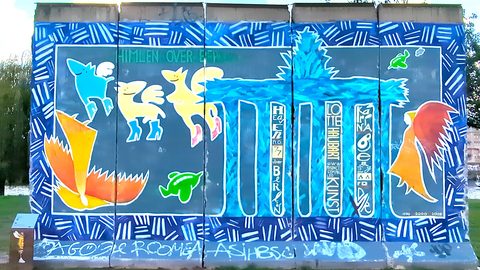
The East Side Gallery runs 1,316 m along Mühlenstrasse between Ostbahnhof and Oberbaumbrücke. This is a Hinterlandmauer (inner wall), not the Grenzmauer 75 outer wall. It is 3.6 m tall. The 101 murals were first applied in 1990, restored in 2009, and the structure has been a protected monument since 1991. It is the longest surviving section still standing, but it is the inner wall, not the frontline wall that faced West Berlin. The outdoor gallery is free and open 24 hours.
Mauerpark: Concrete Behind the Karaoke
Mauerpark along Gleimstrasse and Schwedter Strasse preserves about 300 m of authentic Hinterlandmauer, in situ. The death strip here was converted to a park that opened in 1994. Today it hosts a Sunday flea market and an outdoor karaoke pit. The Wall fragment runs behind the amphitheatre. The park is free.
Where to See the Berlin Wall: Addresses for the Less Obvious Remains
Cemetery Fragments
Invalidenfriedhof has an authentic outer-wall segment about 200 m long along the canal side. It is in situ but partially dismantled. The cemetery itself is a listed site, and the Wall runs along its northern edge. Enter from Scharnhorststrasse. The segment is visible from the street without entering the cemetery.
Liesenstrasse and Gartenstrasse hold about 80 m of authentic Hinterlandmauer integrated into the cemetery wall. This is a quiet, overlooked fragment. It is in situ, visible from the pavement. No other memorial infrastructure exists here; you see the raw concrete as it was left.
Potsdamer Platz: Relocated Segments
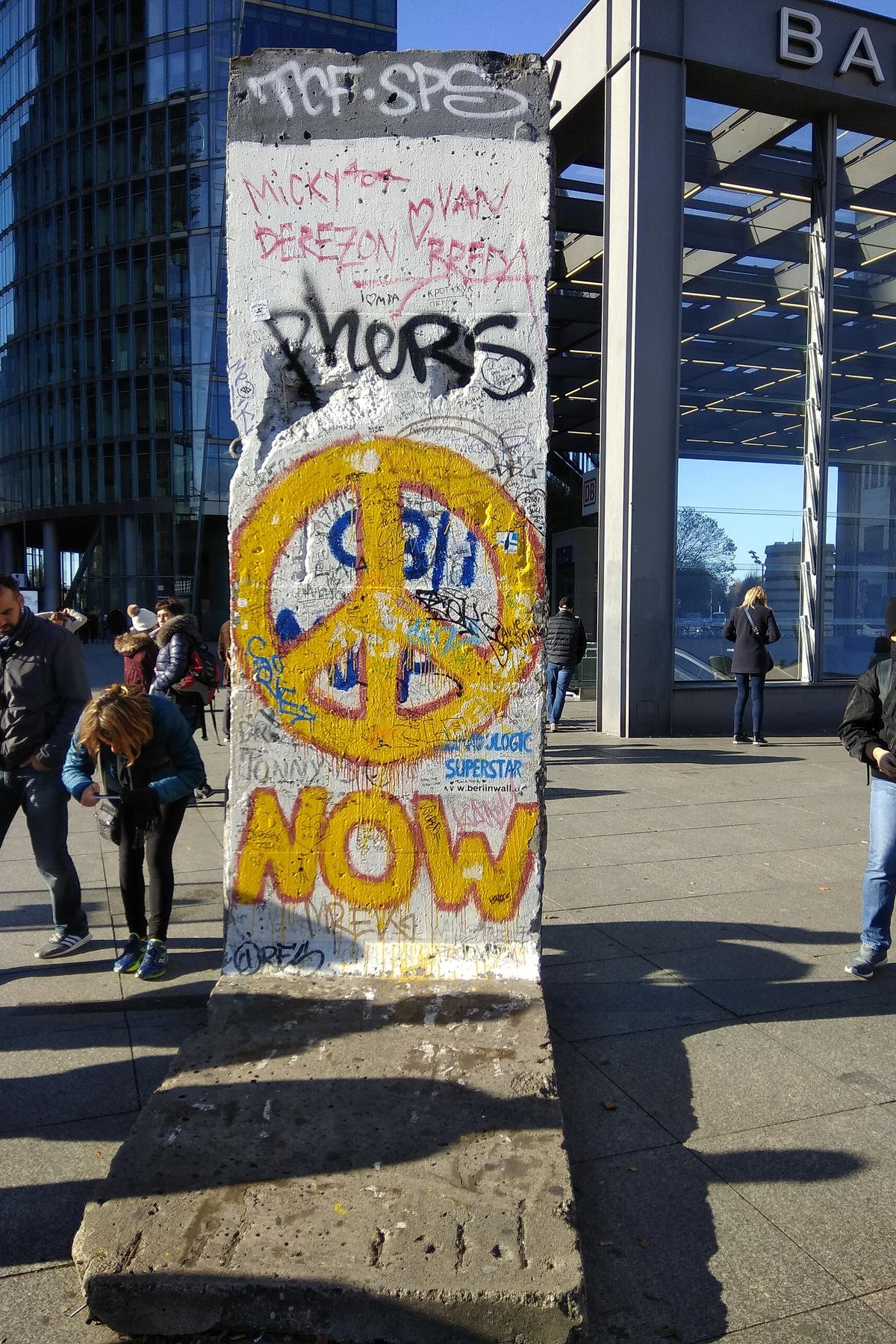
At Potsdamer Platz, six sections of Wall sit outside the S-Bahn station entrance, but these are relocated segments from various inner-city sites, not their original position. They are free to view but contextless. The original course of the Wall ran directly through what is now the Sony Center. The plaque at the site reads 'Berliner Mauer 1961 1989'.
Three Surviving Watchtowers
Three authentic watchtowers survive. The Kieler Strasse watchtower near Invalidenfriedhof is a BT 6 command tower, in situ, listed as a monument. The Erna-Berger-Strasse watchtower near Potsdamer Platz is authentic but relocated within the same area, also listed. The third stands at Niederneuendorfer See on the outer ring. The tower at Bernauer Strasse is a reconstruction, not a surviving original.
Berlin Wall Memorial Sites: What is Original Versus What is Replica
Checkpoint Charlie: Skip the Gate, Skip the Museums
Checkpoint Charlie is a replica. The original guardhouse was removed on 22 June 1990. The current structure was installed in 2000. You see a tourist attraction, not a monument. The site is free to view. Skip the paid museums on either side; they are private, expensive, and the authentic documents are at the Berlin Wall Memorial on Bernauer Strasse.
Bornholmer Strasse: The Opening Point
Bornholmer Strasse border crossing, where the border opened at 23:30 on 9 November 1989, has no surviving Wall remains. A cobblestone marking and plaques show the line. The Bösebrücke bridge itself is authentic, but the Wall segments that stood here are gone.
Kommandantenstrasse and the Cobblestone Trail
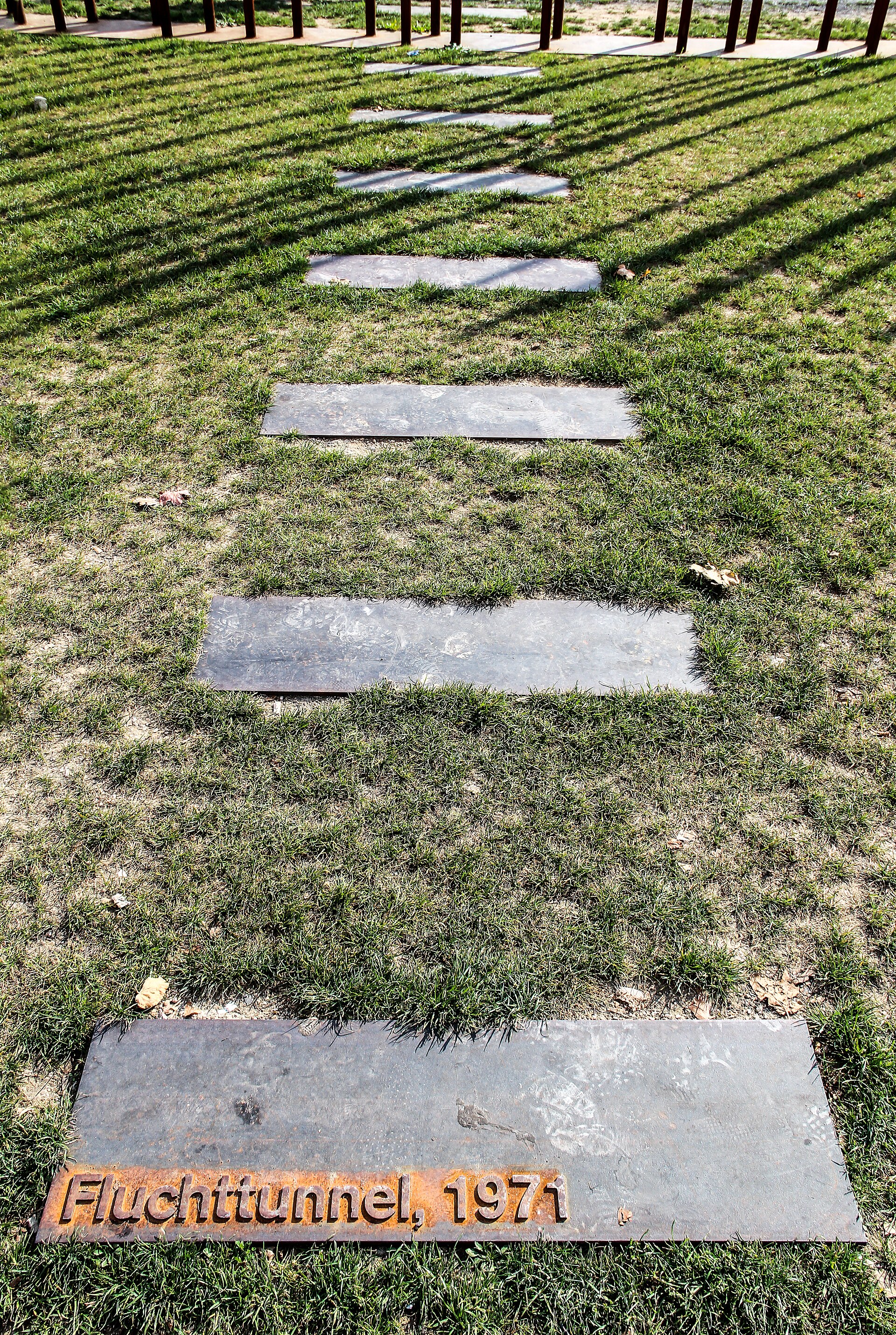
The Kommandantenstrasse site has no above-ground Wall remains at all. The original course ran between Axel-Springer-Strasse and Alte Jakobstrasse. A double row of granite cobbles with brass plaques marks the route. The plaques read 'Berliner Mauer 1961 1989'.
Mauerweg or the Wall Trail runs about 160 km total. The inner-city section is marked by the cobblestone double row. The outer section follows the former border patrol road around West Berlin. White-and-blue 'Berliner Mauerweg' signs guide the route. The cobblestone marking was installed between 2004 and 2006, covering about 5.7 km of the inner-city course. It starts north at Bernauer Strasse and Schwedter Strasse and runs south to Strelitzer Strasse and Liesenstrasse. This is a bicycle or transit route, not a continuous walking path.

Original Berlin Wall Locations: Why They Are Disjointed
Demolition Priorities and Development Pressure
The surviving Berlin Wall locations are scattered because the city demolished the inner-city sections between June 1990 and November 1991 with different priorities. Developers rebuilt on the death strip, especially in areas like Potsdamer Platz, where the 1990s saw Europe's largest construction site transform the no man's land into a corporate canyon. The border strip depth ranged from 30 m to 500 m depending on location, so some parcels were large enough to become parks (Mauerpark) while others were narrow enough to leave Wall segments integrated into existing buildings.
Four Wall Types, Different Survival Rates
Four construction phases created different Wall types: initial barbed wire in 1961, concrete blocks from 1962 to 1965, the Grenzmauer 75 from 1975 to 1980, and the final version up to the end. The remaining fragments are mostly Grenzmauer 75 outer wall (Niederkirchnerstrasse) or Hinterlandmauer inner wall (East Side Gallery, Mauerpark). The inner wall was secondary to the frontline wall in East German thinking, which is why more of it survived. The frontline wall was removed first and more thoroughly.
The East Side Gallery survived because it runs along the Spree riverbank where post-Wall development was slower. The Berlin Wall Memorial on Bernauer Strasse was preserved because the street was the site of the most dramatic escape attempts and the memorial had been planned before the Wall fell. The Mauerpark fragment survived because the area was a railway no man's land that converted slowly. Each fragment has its own preservation story; none is the result of a city-wide plan to keep the Wall intact.
Getting Between Sites
Transit between sites requires the U-Bahn and S-Bahn. Buy a BVG ticket and validate it before boarding. The honour-based system has plainclothes inspectors issuing EUR 60 fines on the spot. Free Wi-Fi is patchy in the former east; BVG public Wi-Fi at U-Bahn stations works after a one-time SMS verification, or buy a local SIM from Aldi Talk for EUR 10.
Read next
-
 East Side Gallery
-
 Checkpoint Charlie
The guardhouse at Checkpoint Charlie is a replica from 2000. Here is what is original Cold War fabric, what is a set, and where the real booth ended up.
Checkpoint Charlie
The guardhouse at Checkpoint Charlie is a replica from 2000. Here is what is original Cold War fabric, what is a set, and where the real booth ended up.
-
 Charlottenburg
-
 Mitte
Mitte
-
 Prenzlauer Berg
-
 Friedrichshain
-
 Neukölln
-
 Kreuzberg
-
 Berlin 1990s Films Run Lola Run Sun Alley and Berlin Babylon What They Captured
Run Lola Run, Sun Alley, and Berlin Babylon each captured a different Berlin of the 1990s — the first a sprint through the post-Wall city, the last a techno-scored documentary of its construction.
Berlin 1990s Films Run Lola Run Sun Alley and Berlin Babylon What They Captured
Run Lola Run, Sun Alley, and Berlin Babylon each captured a different Berlin of the 1990s — the first a sprint through the post-Wall city, the last a techno-scored documentary of its construction.