Tacheles: What Happened to Berlin's Most Famous Squatted Art House
Kunsthaus Tacheles on Oranienburger Strasse was Berlin's most famous squat. After the 2013 eviction and partial demolition, only a street art remnant and a small gallery remain.

Tacheles: What Happened to Berlin’s Most Famous Squatted Art House
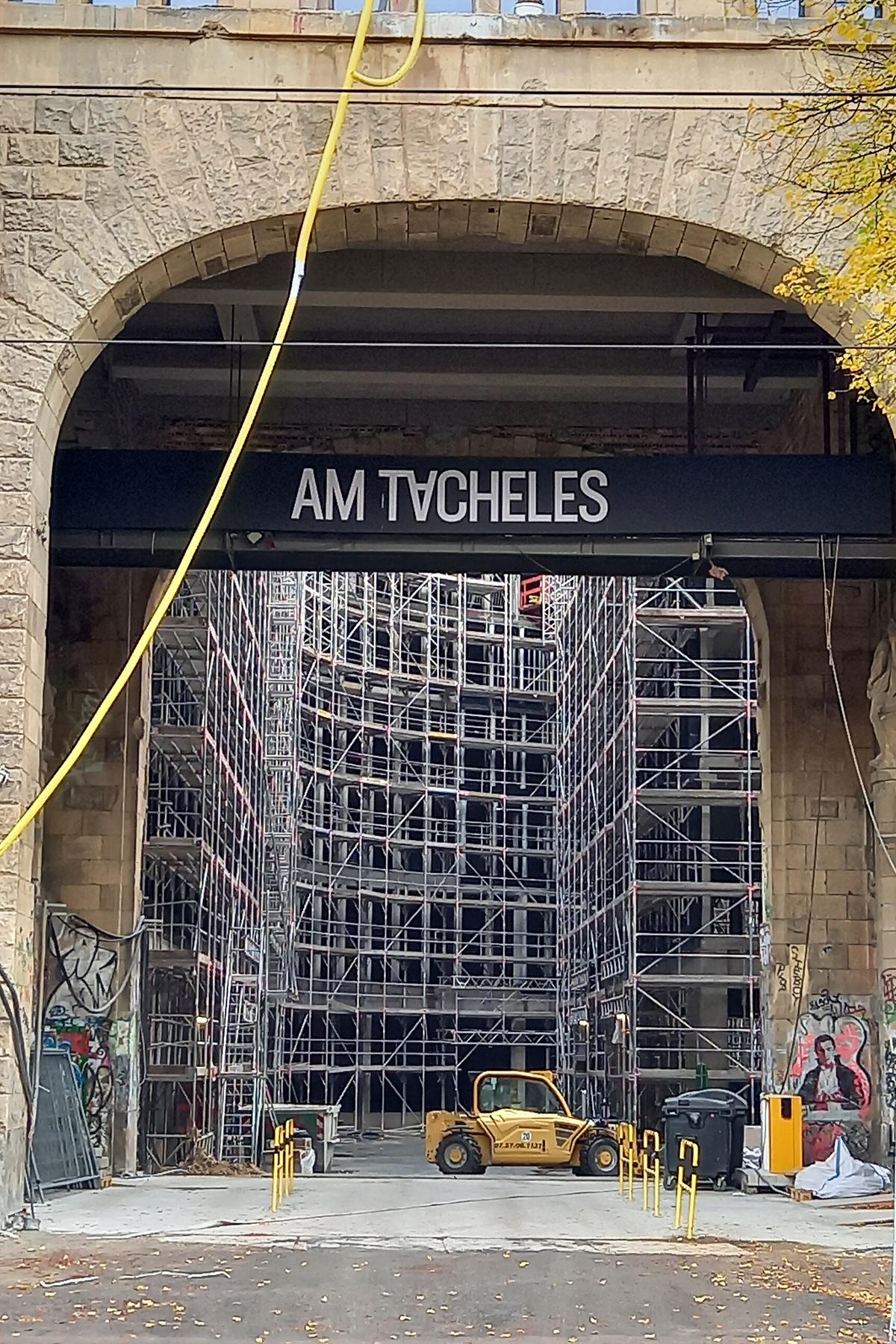
You are looking at a compromise, not a memorial. Most visitors expect a ruin frozen in time. What stands on this street in Mitte is a 25 to 30 metre stretch of the 1908 Beaux Arts frontage, braced with steel beams where the floors used to be, lit at night like a stage set. Behind it, the rear wings are gone. Four new buildings, opened in 2023 as the Am Tacheles Quarter, now occupy the space. The facade is the only original element left standing.
The building began as the Friedrichstraßenpassage, a 1908 shopping arcade designed by Franz Ahrens. After World War II it became the Haus der Technik, a GDR technical centre. When the Wall fell, the structure was slated for demolition. On 13 February 1990, an artist collective called Künstlerinitiative Tacheles occupied it. Demolition started on 4 April 1990. It was halted the next day by a GDR Round Table resolution that declared the site protected, and on 13 April 1990 the building received heritage listing. That 24 hour gap between the first wrecking ball and the intervention is the reason anything exists at all.
What you see now is the main wing and two stub walls facing the street. The rest of the site behind it was demolished in 2014 after the eviction on 4 September 2012. The facade is stabilised. The graffiti from the 1990s is sealed under a consolidant. The word TACHELES is still painted across the upper storey. The vertical HAUS DER TECHNIK lettering remains on one side wing stub. On the southwest column, find the memorial plaque for a firefighter killed in a 1985 Salamander factory explosion. It has nothing to do with the art squat. Nobody removed it.
Tacheles Squat History: from Occupation to Eviction
Between the 1990 occupation and the 2012 eviction, Tacheles functioned as a roughly 60 studio artist collective, a single screen cinema called Kino Tacheles or Atelier am Tacheles seating about 100 people, the Café Zapata bar, and an open air sculpture garden where the Mutoid Waste Company built metal sculptures from scrap. The courtyard bar and the welded creatures became the visual shorthand for what 1990s Berlin looked like when it was still cheap, raw, and unregulated.
Ownership moved from the state to the Fundus Gruppe after 1998, then to HSH Nordbank via a 2008 foreclosure auction where the bank was the sole bidder. In April 2011 the site sold for approximately 5 million euros to Per GmbH, controlled by Johann C. Storm. Eviction came on 4 September 2012. An estimated 600 police officers removed about 40 to 50 remaining occupants. The building was sealed. Partial demolition of the rear and side structures started in 2014.
Tacheles Berlin Today: What Physically Remains
The surviving facade section is the central wing plus two short side wing stubs, running roughly 25 to 30 metres of street frontage. It stands at full height from ground to roof cornice. The internal floors are gone. Steel cross bracing is visible through every window void. The graffiti layers date from 1990 through the early 2010s. They have been sealed and consolidated so they do not wash off or fade further.
The night lighting is a permanent installation, active since the quarter opened in 2023. It makes the ruin readable after dark but also turns it into a backdrop for the new buildings behind it. The original architect Franz Ahrens designed the facade in a Beaux Arts style with Secession elements. The ornamentation is still visible, but it shares every surface with the paint layers from the squat years.
The building's name at this address was Friedrichstraßenpassage in 1908 and Haus der Technik after 1945. Neither name survived in public memory. Tacheles, the Yiddish word for straight talk, replaced them both.
The FOYER Gallery Compromise
Inside the ground floor of the surviving ruin, a small gallery called FOYER operates as an exhibition space. It is the only interior open to the public. Walk in, see the raw interior walls, and recognise how little of the original building survived beyond the front shell. This is not the Tacheles artist collective reincarnated. It is a curated commercial gallery that uses the address without replicating the 1990s structure.
What Was Lost
The rear wings, the courtyard, the open air sculpture garden, the Café Zapata, the Kino Tacheles, and the studio spaces are gone. The 24,000 square metre site now holds four buildings: the surviving ruin plus three new structures housing offices, retail, a Fotografiska photography museum that opened 14 September 2023, gastronomy, and Pure Living serviced apartments. The developer consortium was pwr development with architects Herzog & de Meuron and Grüntuch Ernst Planungsgesellschaft. Ground broke in 2019. The quarter opened in 2023.
Kunsthaus Tacheles Artists and the Golden Era
At peak, the artist collective filled approximately 60 studios. The first large scale exhibition in the ruin ran from 30 June to 27 August 1990, four months after the occupation. The Mutoid Waste Company built the metal sculptures that became the signature courtyard installation. The Zapata bar served drinks in a space that was part ruin, part outdoor living room. The cinema screened films to about 100 seats. The entire operation was self governed, self funded, and deliberately illegal in the eyes of the owner.
The commercialisation of Mitte after reunification made the site untenable. This stretch of the street went from a post Wall no man's land to one of the most expensive retail addresses in Berlin. By the time the eviction came, Tacheles had been a tourist attraction as much as an art space for years. The artists who stayed were the ones who had nowhere else to go. The rest had already moved to Wedding, Friedrichshain, or left Berlin entirely.
The Street Art Remnant on the Facade
The graffiti and painted text on the surviving facade are the only street art from the Tacheles period. The topmost layer was sealed during the stabilisation work. The word TACHELES in large letters is still legible from across the street. On the side wing stub, the HAUS DER TECHNIK lettering dates from the GDR era and was never painted over by the squatters. It reads as a palimpsest of three regimes: Wilhelmine arcade, GDR technical centre, post Wall artist squat.
The tourist plaque installed on the exterior summarises the history in a few paragraphs. It is accurate. It cannot convey the scale of what was lost. The site is now a case study in how Mitte development absorbed and neutralised its most famous 1990s ruin.

How to See the Exterior and Where to Go Next
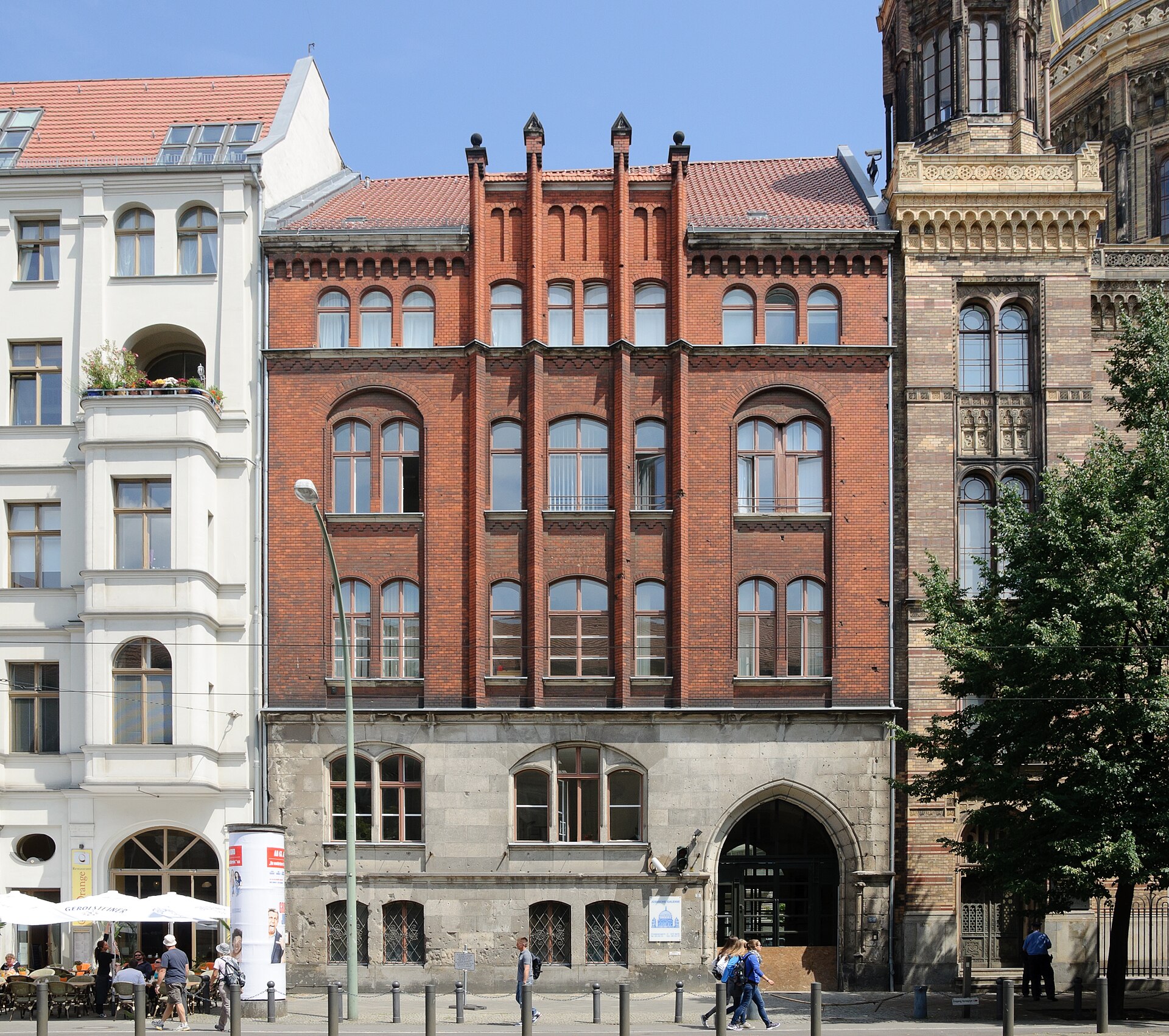
The Tacheles ruin stands on Oranienburger Strasse in the Mitte district. Take the S Bahn to Oranienburger Strasse station, a three minute walk away. U Bahn Oranienburger Tor is five minutes. The address is Johannisstrasse 2, though the main facade faces Oranienburger Strasse.
There is no entry fee for the exterior. Stand on the pavement and you see the entire surviving frontage. The FOYER gallery is open Wednesday to Sunday, from midday to 19:00, but check their schedule because hours shift seasonally. The Fotografiska museum inside the new quarter charges its own admission and is unrelated to the squat history.
Photograph the facade in late afternoon when the sun hits the front directly, or after dark when the permanent lighting installation is active. Morning light leaves the street front in shadow.
To understand the 1990s context, pair this stop with RAW Gelände in Friedrichshain, the East Side Gallery, and a walk through the former squats in Prenzlauer Berg around the Wasserturm. Those three sites together cover the squat movement, the club culture, and the street art that Tacheles once represented on its own.
| Date | Event |
|---|---|
| 13 February 1990 | Künstlerinitiative Tacheles occupies the building |
| 4 April 1990 | Demolition begins on the building |
| 5 April 1990 | GDR Round Table halts demolition, declares Tacheles protected |
| 13 April 1990 | Building receives GDR heritage listing |
| 30 June to 27 August 1990 | First large scale exhibition in the ruin |
| 4 September 2012 | Eviction by approximately 600 police officers |
| 2014 | Demolition of rear and side structures |
| 2023 | Am Tacheles Quarter opens with Fotografiska Berlin |
Who Should Skip This and What Often Goes Wrong
This site is for Cold War history completists, 1990s club culture pilgrims, urban exploration and architecture nerds, second time Berlin visitors digging past the greatest hits, and photographers chasing post industrial decay. Skip it if you are a first time Germany visitor wanting a fairy tale old town. Berlin's 1990s layer is broken, sprawling, and emotionally heavy.
The single thing that most often goes wrong here is arriving expecting an art space with studios and a bar. The courtyard bar, the sculpture garden, the cinema, and the artist studios are gone. What remains is a facade held up by steel. If you need to explain to a travel companion why a stabilised ruin with new luxury apartments behind it matters, start with the fact that the building was saved by a political intervention that happened in a single 24 hour window in April 1990. The site now embodies exactly the commercialisation the squat was trying to resist.
Read next
-
 East Side Gallery
-
 Checkpoint Charlie
The guardhouse at Checkpoint Charlie is a replica from 2000. Here is what is original Cold War fabric, what is a set, and where the real booth ended up.
Checkpoint Charlie
The guardhouse at Checkpoint Charlie is a replica from 2000. Here is what is original Cold War fabric, what is a set, and where the real booth ended up.
-
 Charlottenburg
-
 Mitte
Mitte
-
 Prenzlauer Berg
-
 Friedrichshain
-
 Neukölln
-
 Kreuzberg
-
 Berlin 1990s Films Run Lola Run Sun Alley and Berlin Babylon What They Captured
Run Lola Run, Sun Alley, and Berlin Babylon each captured a different Berlin of the 1990s — the first a sprint through the post-Wall city, the last a techno-scored documentary of its construction.
Berlin 1990s Films Run Lola Run Sun Alley and Berlin Babylon What They Captured
Run Lola Run, Sun Alley, and Berlin Babylon each captured a different Berlin of the 1990s — the first a sprint through the post-Wall city, the last a techno-scored documentary of its construction.