Palast der Republik: Closed 1990, Gone 2008, Replaced 2020
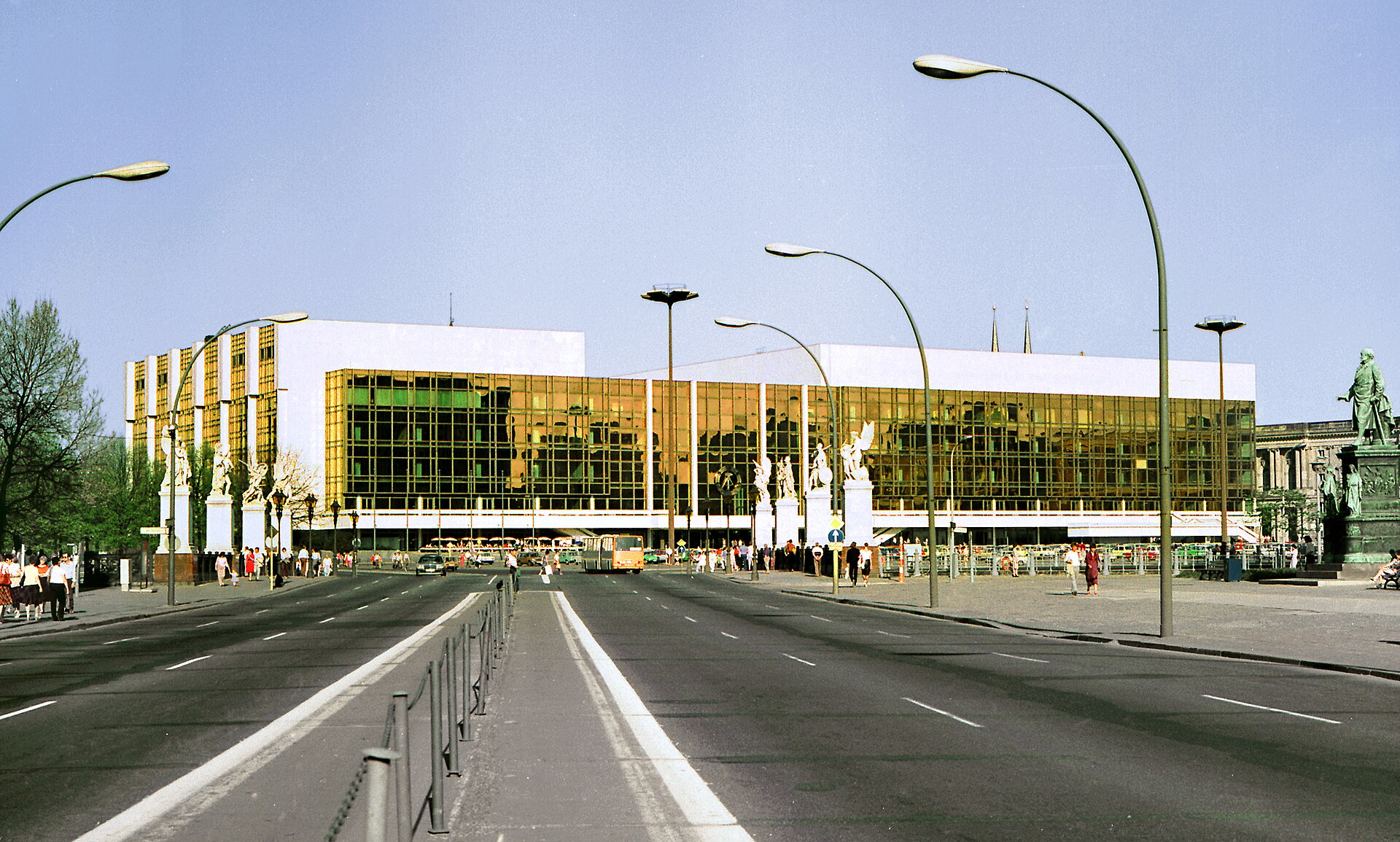

Palast Der Republik: Closed 1990, Gone 2008, Replaced 2020
Schlossplatz, in Berlin's Mitte district, has seen three buildings in one lifetime. The Hohenzollern Stadtschloss was dynamited in 1950. In its place rose the GDR's Palast der Republik, which opened in 1976, closed in 1990, and was taken apart between 2006 and 2008. The Humboldt Forum opened on the same spot in 2020. You are standing on Schlossplatz looking at a Baroque palace facade. It is not a palace. It is a 21st-century museum containing ethnographic collections, art, and event spaces. The concrete-and-bronze structure that stood here for 32 years housed the Volkskammer, the GDR parliament, plus bowling alleys, restaurants, and a theatre. Both buildings existed within a single human lifespan.
What Was the Palast Der Republik? the GDR Parliament Building Berlin
The Structure and Its Architect
The Palast der Republik opened on 23 April 1976 on the cleared site of the former royal residence, which the GDR government had demolished in 1950. Heinz Graffunder designed a 180-metre-long, 85-metre-wide block clad in bronze mirrored glass. It held 80,000 m² of floor space. The steel frame weighed 5,000 tonnes. Construction consumed 485 million East German marks. Erich Honecker inaugurated it as a "people's palace" for both political sessions and public leisure. Its heft earned it the nickname "Ballast der Republik".
What Was Inside
The Volkskammer chamber seated 500 representatives. A main auditorium held 5,000 people and a smaller theatre held 1,000. Visitors found 13 bowling lanes, 13 restaurants and bars, and 1,001 lamps. The building was a parliament and a leisure centre in equal measure.
Why the Palast Der Republik Closed: 1990 and the Asbestos Problem
On 19 September 1990, weeks before reunification, the Palast closed to the public. The reason was crocidolite. Blue asbestos, a highly carcinogenic fibre, had been sprayed throughout the steel frame during construction. Workers extracted 720 tonnes of the material over five years, finishing in 1995. The structural shell remained standing, sealed and empty, from 1995 to 1998.
The closure was not a political decision. It was a public health order. But the timing meant the newly unified German state inherited a contaminated structure on the most valuable empty land in Mitte, directly across from Museumsinsel and Unter den Linden. The debate over whether to tear the Palast down and reconstruct the old royal residence, or to preserve it as a cultural venue, ran for more than a decade.
The Volkspalast: Interim Use from 2003 to 2005
After the hazardous-material removal, the shell sat empty for years. From 13 August 2003 to 20 November 2005 it operated as the Volkspalast, an interim art and event space. The name revived the "people's palace" idea without the GDR baggage. Over 650,000 visitors attended 2,000 events. The final event was "Abschied vom Volkspalast" on 20 November 2005.
The interim use did not alter the demolition decision. The argument had already shifted to reconstruction, funded by a private campaign. Donors contributed to the three reconstructed Baroque facades; check the Stiftung Humboldt Forum website for the current fundraising total.
The Demolition: Palast Der Republik Demolition 2006-2008
The Teardown
Dismantling began on 6 February 2006 and ended on 2 December 2008. Bilfinger Berger was the contractor. The 5,000-tonne steel frame was cut apart. Because of the asbestos history, every piece was handled as hazardous material. The final cost ran to tens of millions; the Stiftung Humboldt Forum publishes the audited figure.
The Fight Over the Site
The teardown was contentious. Protesters argued the Palast represented the Volkskammer, the only democratic institution of the GDR era. Supporters of reconstruction countered that the Baroque palace, which had stood for 500 years, was a more fitting centrepiece for the historical core of the city. The site was cleared by December 2008 for what would become the Humboldt Forum.
The Berliner Schloss Reconstruction and the Humboldt Forum Berlin
The Facades and the Architect
The reconstruction project rebuilt three Baroque facades: north, west, and south. The east facade, facing the Spree, is a modern design by Franco Stella. The entire complex opened on 16 December 2020. The Stiftung Humboldt Forum im Berliner Schloss operates it. The total construction budget was set by the federal government; consult the Stiftung's annual report for the final audited cost.
What the Building Holds
The Forum has 40,000 m² of floor space, half the size of the Palast. It houses the ethnographic collections of the Staatliche Museen zu Berlin, including non-European art and artefacts, plus exhibition halls, a restaurant, and event spaces. It is a museum and cultural centre, not a residential palace.
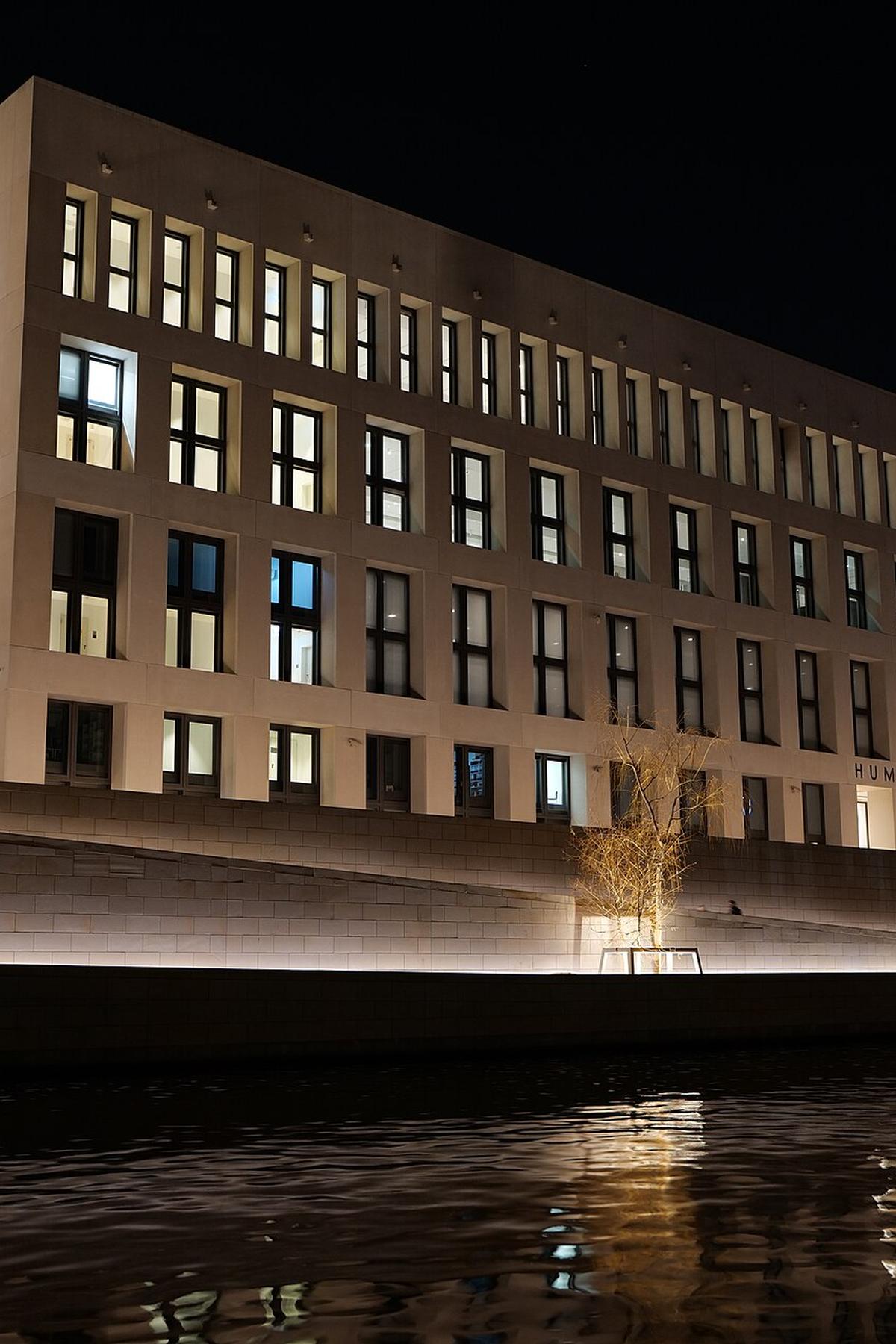

Palast Der Republik Artifacts Preserved Inside the Humboldt Forum
Structural Remnants
Five original steel frame columns were preserved and reinstalled in the Schlüterhof passage. One set of bronze front doors stands at Portal III. A granite staircase survives on the ground floor. Twelve original lamps are reinstalled. Two luminous ceiling elements from the 1,001 originals sit in a ground-floor passage. One section of wooden wall panelling and two sections of staircase balustrade are also on the ground floor.
The Relief and the Seats
The interior wall relief "Unser Leben" hangs on the ground floor near the Schlüterhof. Most strikingly, 144 original theatre seats are preserved and reinstalled in the ground-floor foyer. These fragments are the only physical remnants of the demolished structure. Everything else was removed.
How to See the Site Today: Schlossplatz and the Humboldt Forum
Getting There
Go to Schlossplatz, the square between the Spree and the east side of the Forum. The address is Schlossplatz 2, 10178 Berlin. Take the S-Bahn to Hackescher Markt, a ten-minute walk, or the U-Bahn to Museumsinsel, five minutes away.
Opening Times and Tickets
The Forum is open daily from 10:00 to 20:00. It closes Mondays. General admission to the ground-floor exhibitions is free. You need a ticket for the upper-floor ethnographic collections. Book in advance online; time slots fill.
Finding the Palast Fragments
The preserved artifacts are on the ground floor, accessible without a ticket. Head to Portal III for the bronze doors. Find the theatre seats in the foyer. Walk into the Schlüterhof passage, an interior courtyard, to see the five steel columns. The "Unser Leben" relief is on the wall near that courtyard.
Who This Site is for and Who Should Skip it
Go If
This site is for Cold War history obsessives tracing the GDR's architectural legacy. It is for urban explorers and ruin enthusiasts who followed the demolition debates. It is for architecture students of adaptive reuse: you see a Baroque facade built in the 2010s that contains fragments of a 1970s modernist structure that replaced a 1700s palace.
Skip If
Skip it if you want a pampered city break. Skip it with young children expecting fairy-tale charm; the ethnographic exhibitions include human remains and colonial objects that require context. Skip it if you dislike vast distances between sights. Museumsinsel is large, and the Forum is one stop among several. Budget three full days in Berlin to cover the central sites and the peripheral Cold War locations like the Bernauer Strasse Wall Memorial and the Bösebrücke crossing.
Read next
-
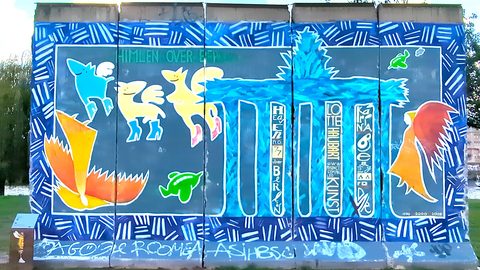
 East Side Gallery
-
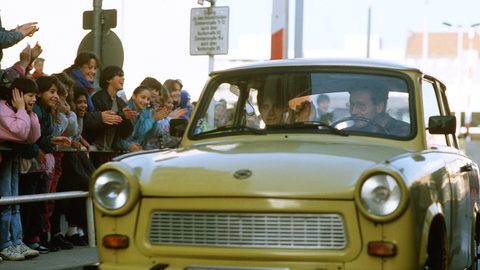 Checkpoint Charlie
The guardhouse at Checkpoint Charlie is a replica from 2000. Here is what is original Cold War fabric, what is a set, and where the real booth ended up.
Checkpoint Charlie
The guardhouse at Checkpoint Charlie is a replica from 2000. Here is what is original Cold War fabric, what is a set, and where the real booth ended up.
-
 Charlottenburg
-
 Mitte
Mitte
-
 Prenzlauer Berg
-
 Friedrichshain
-
 Neukölln
-
 Kreuzberg
-
 Berlin 1990s Films Run Lola Run Sun Alley and Berlin Babylon What They Captured
Run Lola Run, Sun Alley, and Berlin Babylon each captured a different Berlin of the 1990s — the first a sprint through the post-Wall city, the last a techno-scored documentary of its construction.
Berlin 1990s Films Run Lola Run Sun Alley and Berlin Babylon What They Captured
Run Lola Run, Sun Alley, and Berlin Babylon each captured a different Berlin of the 1990s — the first a sprint through the post-Wall city, the last a techno-scored documentary of its construction.