Mauerpark: The Death Strip Wasteland Turned Flea Market and Karaoke Pit
Mauerpark began as a Wall death strip between Wedding and Prenzlauer Berg, became a 1990s wasteland, and is now Berlin's Sunday flea market and open-air karaoke pit.
.jpg)
Mauerpark Berlin Death Strip: a Sunday Spectacle on a Killing Ground
On a Sunday in late spring, 40,000 to 50,000 people crowd a long, narrow park in Berlin that was, until 1989, the most dangerous piece of land in the city. The Mauerpark Berlin death strip ran between Wedding in West Berlin and Prenzlauer Berg in East Berlin. Today that same strip of sand and gravel hosts the Sunday flea market, the Bearpit Karaoke pit, and a busking scene that runs from noon until the last train. The transformation from a cleared killing zone to a mass public gathering is not a feel-good story about urban renewal. It is a story about how Berlin let a wasteland sit for years, and how the city only moved in when the people who used it forced the issue.
The Wall’s Geography: Wedding and Prenzlauer Berg Meet at the Death Strip
The border between Wedding and Prenzlauer Berg was never a straight line. The Wall made it a double barrier: an outer wall facing West Berlin, a hinterland wall facing East Berlin, and between them the Grenzsicherungsstreifen, the death strip. East German guards in watchtowers shot anyone who crossed the sand. The footprint of one GDR watchtower is still visible in the grass on the southern slope above the amphitheatre. The eastern side inner wall survives along that slope, parallel to Eberswalder Strasse. It is a 30-metre section of the standard Grenzmauer 75 prefabricated concrete L elements. That short fragment is the only original border element left on the site. Everything else was dismantled by 1994.
1990 to 1994: the Wasteland Years
Four Years of Legal Limbo
After the Wall fell in November 1989, the border strip was cleared of its military infrastructure. The western outer wall came down first. The hinterland wall stayed for a few years. What remained was a flat, sandy void between two very different districts. Prenzlauer Berg, on the east side, was a dense, prewar tenement neighbourhood with crumbling buildings and squatted apartments. Wedding, on the west, was a working-class district with cheaper rents and a rougher edge. The empty strip between them became an informal space. Locals walked dogs there. Kids kicked balls. No one had permission to use it because no one owned it. The land sat in a legal limbo that lasted four years.
Gustav Lange's Minimal Design
The city hired landscape architect Gustav Lange in 1993. His 1994 design for the park was minimal: grass, a few paths, a large open field. It was not a grand vision. It was the cheapest way to turn a liability into a public amenity. The park opened in 1994 as a flat, unprogrammed green space. No playground, no café, no benches worth sitting on. The Jahnsportpark, the former East Berlin Friedrich Ludwig Jahn Sportpark, sat adjacent and handled the organised sports. Mauerpark handled everything else by default.
Mauerpark History Wall: the Border Element That Stayed
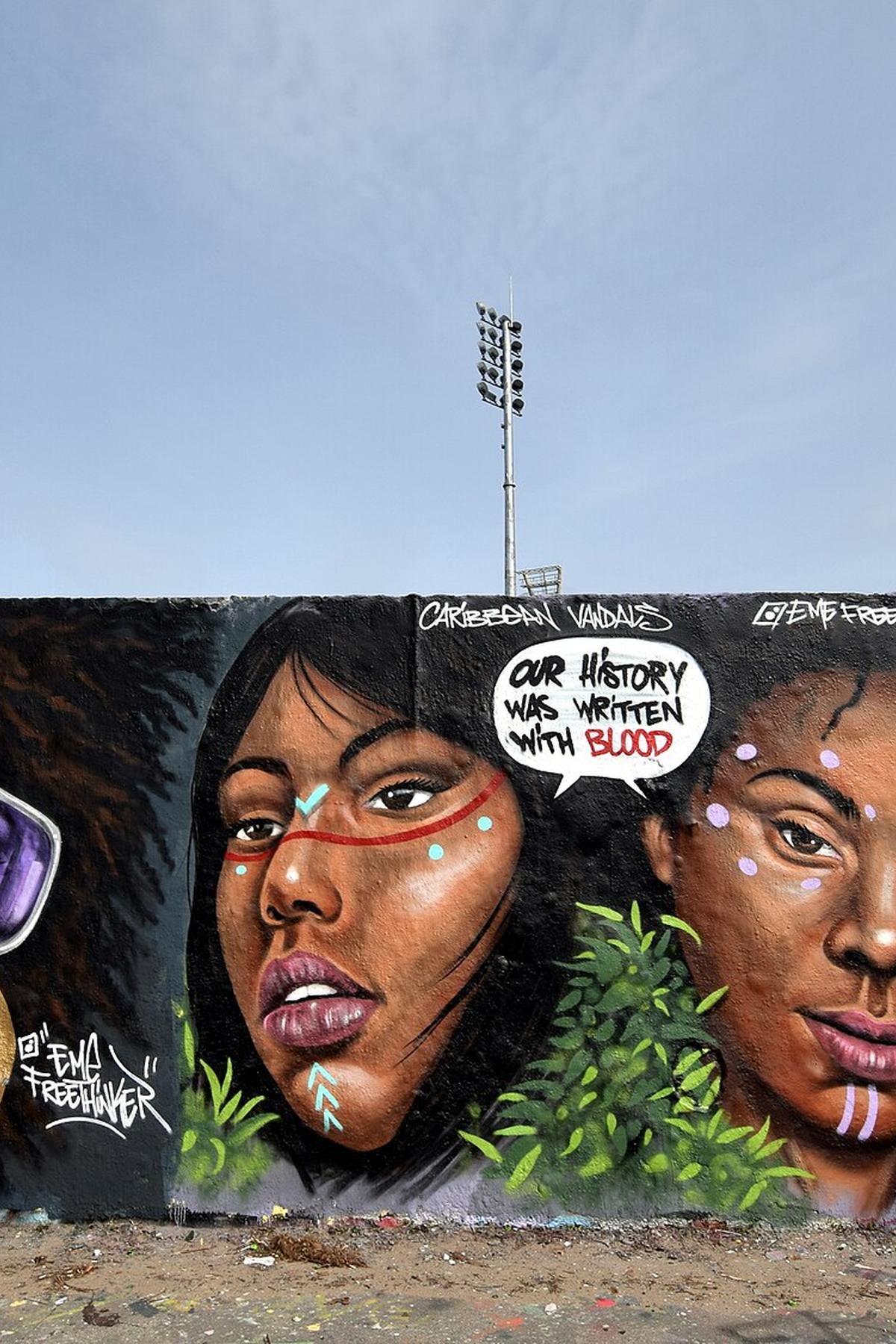
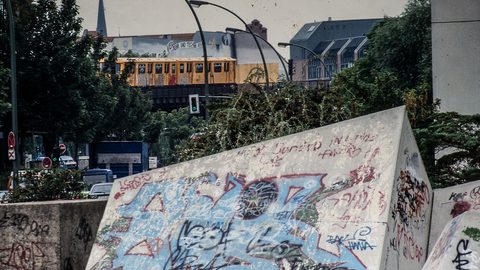
The 30-metre wall section on the Falkplatz slope is the only physical piece of the border that a visitor can touch inside Mauerpark. It is a hinterland wall section, the eastern side inner wall, built to keep East Berliners from approaching the death strip. The graffiti on it is recent. During the 1990s it was bare concrete. The wall survived because it was embedded in the slope and removing it would have cost more than leaving it. It now serves as the backdrop for the amphitheatre steps. Walk up the grassy slope south of the Bearpit to reach it. The wall faces Eberswalder Strasse and the U-Bahn viaduct. Do not confuse it with the longer painted sections at the East Side Gallery or the preserved segment at the Berlin Wall Memorial on Bernauer Strasse. That site, a 15-minute walk north, preserves a full death strip with the outer wall intact. Mauerpark preserves only the inner wall, and only for 30 metres.
Mauerpark Flea Market Guide: from 2004 to 40,000 Sundays
How the Market Started
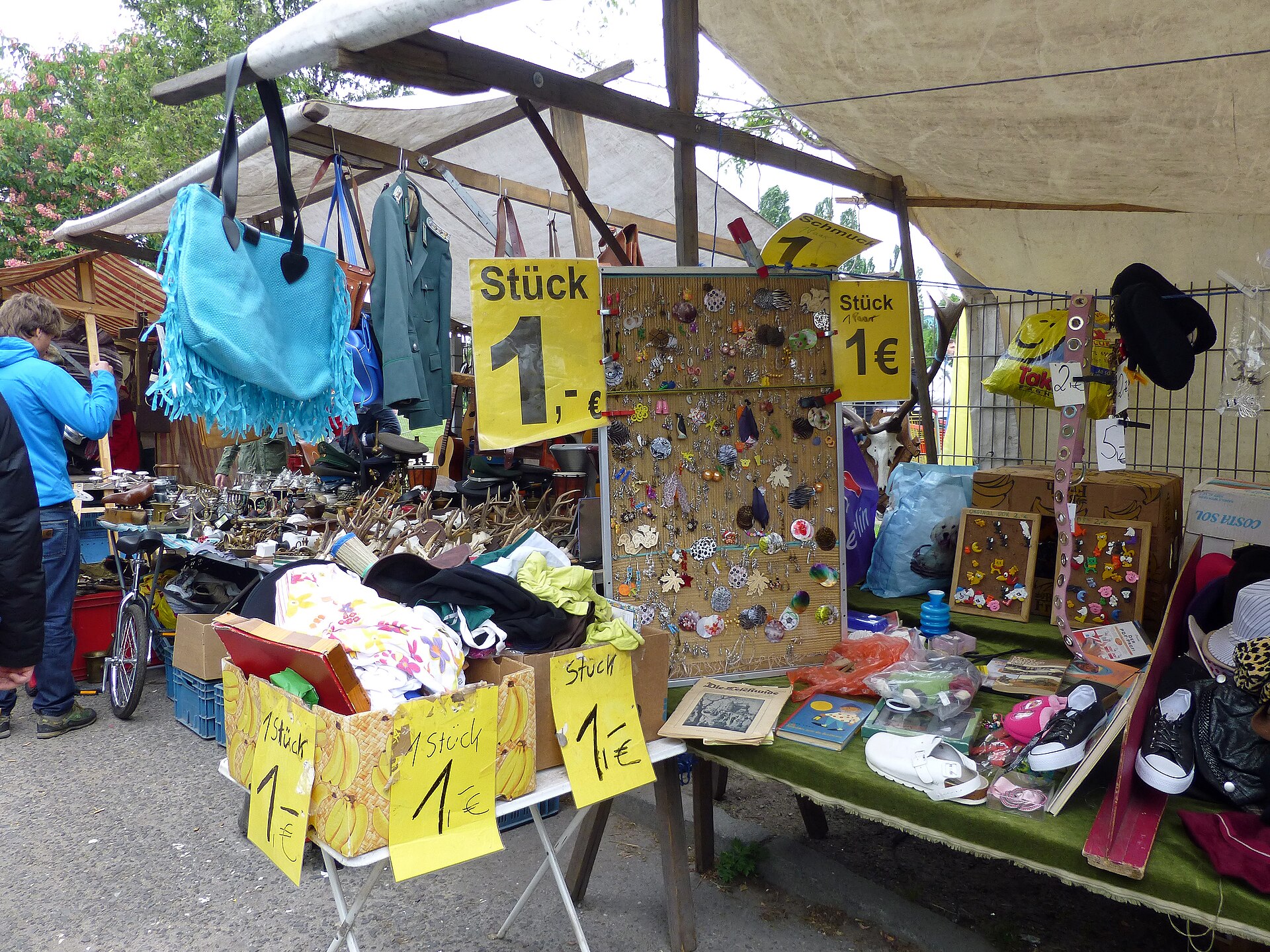
The Sunday flea market, the Flohmarkt am Mauerpark, did not start in the 1990s. It began in 2004, a full decade after the park opened. The first edition was small: a few vendors with blankets on the gravel. The market grew because Prenzlauer Berg was gentrifying and Wedding was still cheap, so the border strip became a natural meeting point for two different economies. Sellers from Wedding brought tools, records, and household goods. Sellers from Prenzlauer Berg brought vintage clothing, design objects, and the leftovers from flat clear-outs.
When to Arrive and What to Know
The market runs Sundays from 09:00 to 18:00. On a peak Sunday it draws the same 40,000 to 50,000 people that fill the whole park. Arrive by 09:00 to browse before the crowd hits. After 11:00, the paths between the stalls become impassable in the central section. The market runs along the western edge of the park, near the Brunnenstrasse entrance. Bring cash. Most stalls do not take cards. The nearest ATM is at the Eberswalder Strasse U-Bahn station, and the queue on a Sunday is long.
Mauerpark Karaoke Sunday: the Bearpit That Swallows the Afternoon
Bearpit Karaoke is the reason most visitors under 35 come to Mauerpark. It happens in the stone amphitheatre built into the southern slope, directly below the 30-metre wall section. The karaoke runs every Sunday from mid-March to late October. Start time is 15:00. There is no microphone. There is no stage. A single speaker sits at the bottom of the pit. The crowd on the grassy slope above shouts the lyrics back. The system is simple: anyone who wants to sing puts their name in, and the host, a rotating roster of regulars, calls them up. The quality ranges from genuinely good to deliberately terrible. The crowd is loud either way.
Arrive by 14:30 if you want a spot on the slope with a view of the singer. Arrive by 15:30 and you will be standing at the top of the pit, watching over shoulders. The karaoke ends when the host stops, around 18:00, which is also when the flea market vendors start packing. If you want to sing, put your name in during the first 30 minutes. The waitlist fills fast.
Berlin Death Strip Parks: Mauerpark and the City’s Other Border Voids
Other Parks Built on the Border
Mauerpark is not the only Berlin death strip park, but it is the most successful. Görlitzer Park in Kreuzberg is another: a former freight station that became a death strip adjacent park, now a grassy expanse with a drug scene the city tolerates. The Insel der Jugend in Treptow sits on a riverside no man's land that was a GDR youth club before becoming a 1990s rave spot. The Spreepark abandoned ferris wheel in Treptow was a GDR amusement park that failed after reunification and now sits as a ruin you can only visit on a guided tour.
What Separates Mauerpark
What separates Mauerpark from these sites is the flea market and the karaoke. The others are quieter, emptier, and more atmospheric for the Cold War history completist. If you are a second-time Berlin visitor digging past the greatest hits, the Insel der Jugend beer garden on a summer afternoon beats Mauerpark on a Sunday. But if you want to see 50,000 people occupy a death strip without a second thought, Mauerpark is the only place that delivers it.
.jpg)
A Non-Sunday: What the Park Looks Like Empty
On a Tuesday afternoon, Mauerpark is almost empty. The flea market stalls are gone. The karaoke speaker is locked away. The grassy slope above the amphitheatre has a few people lying on it. The main field hosts unregulated ball games. This is closer to what the park was in the 1990s than what it is on a Sunday. The graffiti wall along the southern slope is still there. The 30-metre hinterland wall section is still there. The watchtower footprint in the grass is still there. But the crowd is not. If you want to photograph the wall section without people in the frame, come on a weekday morning. If you want to understand why the park matters, come on a Sunday and let the crowd show you.
Getting There and Getting Out
Arriving by Public Transport
The closest U-Bahn stop is Eberswalder Strasse on the U2 line. From Alexanderplatz, it is four stops and eight minutes. Exit the station and walk south along Eberswalder Strasse. The park entrance is on your left after a short walk. If you are coming from Wedding, walk east from the Brunnstrasse S-Bahn stop. That entrance drops you directly into the flea market.
What Not to Do
The park has no dedicated parking. Do not drive. The nearest taxi drop-off is on Bernauer Strasse, a 10-minute walk north.
The Backup Plan
If the park is too crowded to move, walk 10 minutes north to the Berlin Wall Memorial on Bernauer Strasse. It has the same history, a preserved death strip, a visitor centre, and far fewer people. If the karaoke waitlist is full and the flea market is shoulder to shoulder, the memorial is your backup.
The Grit That Remains
The thing that most often goes wrong for visitors to Mauerpark is the expectation that a death strip turned park should be a solemn memorial. It is not. The crowd is loud. The karaoke is bad. The flea market sells cheap plastic toys next to vintage Leica cameras. The graffiti on the wall section is not curated. The Mauersegler, the swifts that nest in the prewar tenement eaves along Bernauer Strasse, scream overhead in summer. The park has no signage explaining the watchtower footprint. You have to know it is there to find it. That is the point. Mauerpark is not a monument. It is a place that became a park because the city did not know what else to do with a strip of sand between two districts, and the people who lived there filled the void on their own terms.
Read next
-
 East Side Gallery
-
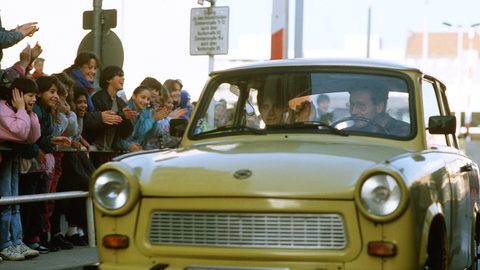 Checkpoint Charlie
The guardhouse at Checkpoint Charlie is a replica from 2000. Here is what is original Cold War fabric, what is a set, and where the real booth ended up.
Checkpoint Charlie
The guardhouse at Checkpoint Charlie is a replica from 2000. Here is what is original Cold War fabric, what is a set, and where the real booth ended up.
-
 Charlottenburg
-
 Mitte
Mitte
-
 Prenzlauer Berg
-
 Friedrichshain
-
 Neukölln
-
 Kreuzberg
-
 Berlin 1990s Films Run Lola Run Sun Alley and Berlin Babylon What They Captured
Run Lola Run, Sun Alley, and Berlin Babylon each captured a different Berlin of the 1990s — the first a sprint through the post-Wall city, the last a techno-scored documentary of its construction.
Berlin 1990s Films Run Lola Run Sun Alley and Berlin Babylon What They Captured
Run Lola Run, Sun Alley, and Berlin Babylon each captured a different Berlin of the 1990s — the first a sprint through the post-Wall city, the last a techno-scored documentary of its construction.